
Alex Lifeson: Rush Hour
Flashing back to discussing gear (and unexpected visits from the police) with Rush's lead guitarist

Greetings, loyal JTL readers!
I am now in what looks like my final week of deadline insanity on the Electro-Harmonix book project, so once again I’m exhuming an old favorite post from deep in the Jagged Time Lapse vaults to tide you over.
This time, inspired by the exciting surprise announcement that Geddy Lee and Alex Lifeson — the two surviving members of Rush — will be reuniting next year for a headlining tour (with drummer Anika Niles filling in for the late Neil Peart), I thought I’d treat you all to an interview I did with Lifeson back in 2020.
When it originally ran here in its entirety in March 2023, I put it up (as I usually do with my interviews) as something solely for my paid subscribers to read. Today, however, the Q&A is available for all. But I have some really cool “paid only” content coming up — including recent interviews with Roxy Music’s Phil Manzanera, Colin Blunstone of the Zombies, and a 2007 interview with Ian Hunter that I just recently unearthed — so if all that sounds like your cup of groove, please hit the button below to upgrade your subscription.
For only $5 a month, or $4.17/mo if you opt for the annual subscription option, you’ll enjoy access to all of the exclusive interviews in the JTL Vault, along with the completed chapters of my adolescent musical memoir-in-progress — like this one about discovering marijuana and Foghat Live on the same bus ride, or my ill-fated first “band practice” — and all the full episodes of CROSSED CHANNELS, the monthly music podcast I do with my friend and fellow scribe Tony Fletcher. (Our 21st episode, this one on the subject of Northern Soul, will be up later this week!)
I think that’s a pretty solid value for just the price of one large coffee drink or pint of beer per month — and if you do too, and would like to support good independent music writing in this dire media landscape, please click the button below and head to the “paid subscription” option. A thousand thanks to all of you who have already done so; you quite literally keep the lights on over here.
(And FYI: if you already have a paid JTL subscription but find that you can now no longer access my “paid-only content,” please check to see if the credit card you have on file needs to be updated.)
And now, on with our featured presentation…

I fell in love with Rush during the very first weeks of 1980. “The Spirit of Radio” and “Freewill” from their then-latest album Permanent Waves were in regular rotation at the time on Chicago’s FM rock giants WLUP and WMET, and I was completely taken by the Canadian band’s intensely hard-rocking mixture of technical proficiency, articulate lyrics and serious “outsider” vibes. (I wrote a piece for The Forward back in 2020 about how much Permanent Waves meant to me at the time, which can still be found here.)
I admit that I dropped them for a while during the second half of the ‘80s — both because Rush started unexpectedly sounding like The Police (a band I’d always loathed) and because their whole “prog-rock power trio with conceptual lyrics” shtick seemed anathema to whatever already-outdated punk precepts I had aligned myself with at the time. But I got back into their seventies stuff around 1990, and even managed to see one of their shows on the Test for Echo tour, which I’m not ashamed to say kicked some serious ass.
So it was a real thrill for me when I got to interview Rush vocalist/bassist Geddy Lee in 2004 around the release of their Feedback EP (a Q&A that I will try to dig up at a later date), and when I was able to talk to his guitar counterpart Alex Lifeson for this interview in 2020. My conversation with Alex was done for the Stompbox book project, so it was pretty gear-intensive. (I was also warned ahead of time by his publicist not to bring up Rush drummer/lyricist Neil Peart, whose death a few months earlier was still a very painful subject.)
But I think Alex’s personality — charming, laidback, and far more self-effacing than you’d expect from a man who has been hailed for decades as a genuine guitar god — comes through rather nicely in the course of our conversation.
Okay, Alex — so what was your first guitar pedal?
Well, If I go back to the beginning, I think the first pedal that I used was a distortion box. It was like a little box, and I can’t remember if it was a custom-made thing — and when I say “custom-made,” I mean like in someone’s garage. [laughs] But I plugged my guitar into it, and then from that I would plug into the RCA adaptor on the back of our TV, and I would play through the TV! This was in 1967, I guess. I can’t remember where I got that, but I was just so blown away with it. And the Stones with “Satisfaction” and Keith Richards’ distorted guitar sound on the riff — it was like, “YEAH!!! That’s what I want!” But I think I had to give it back to whomever I borrowed it from. [laughs]
Did that pedal open your mind to the possibilities of guitar effects?
Yeah, I think I was interested in that, right from the beginning. And even now, all these years later, when I’m writing or recording, that’s what I go to; any guitar part I do, I want to manipulate it and make it sound not like a guitar — I look for a really interesting sound that works in the context of a song. I think I’ve always had that in me; I’ve always wanted to explore where a sound can go, and how you can change it and make it something unique and interesting. I mean, why not? And now, of course, there are so many effects. It’s a really giant industry!
But there’s also something about a guitar and cable straight into an amp, that purity of that whole sound… there, I just said how much I love manipulating my guitar sound to make it not sound like a guitar, and now I’m saying something completely the opposite. [laughs] There’s a time and a place for everything, I guess. These days, everything I record or write, or any of the projects that I do, I’m always looking to manipulate it and make it different, make it not me. I want to take it to another level that’s not rock-related or Rush-related. Mostly for me — it’s just more fun!
So what was the first pedal that you actually owned?
So I think my first real pedal was a Cry Baby wah-wah that I actually purchased and saved up for. And I fell in love with it — “White Room” by Cream, so many Jimi Hendrix songs. it was a really cool thing. You’d put it in that sort of “mid mode” to get that nasally sort of sound, and I’ve often used that throughout my career. Like the solo in “Red Barchetta,” for example — that’s the pedal kind of on a half-way sweep.
When I got an Echoplex, that was sort of the next big thing I got, and I absolutely loved that. I loved that sound, and doing things in syncopation… but it wasn’t until the chorus pedal came along — I think that had the greatest influence on me. I also had a Maestro phase shifter; it was like a box with three rocker switches on it, for mild, medium, and heavy. It was just a phase unit, but it approximated that chorus-y kind of sound. Modulation effects — Delay, Chorus, Phasing — were really my main effects.
How did you get into the Boss CE-1 pedal?
I remember we were in Rockfield in Wales; we were recording A Farewell to Kings. I had my regular amps — the Marshalls and Hiwatts — but we got in a JC 120, which I think Roland just released around that time. And man, I’m telling you, I would sit in front of that thing and just play for hours, just to hear that sweeping chorus go by, you know, between the speakers. It was a stereo thing in a mono world. [laughs] I was like, “Oh my god, this is amazing!” I ended up using it quite a bit on that record.
And then they released the CE-1 pedal, and I started using that on just about everything. I think most of Signals was done with that chorus pedal turned on! [laughs]
You picked the CE-1 up for the Farewell to Kings tour, right?
Right, yeah. They released that pedal I think soon after they released the amp line. I got that pedal, and it was the most used part of my rig. But I’ve always had lots of gear, lots of effects; I’ve always been interested in how to manipulate the guitar sound, and how to enhance it and make it bigger than a guitar normally would be — the character of it and size. And that was very effective.
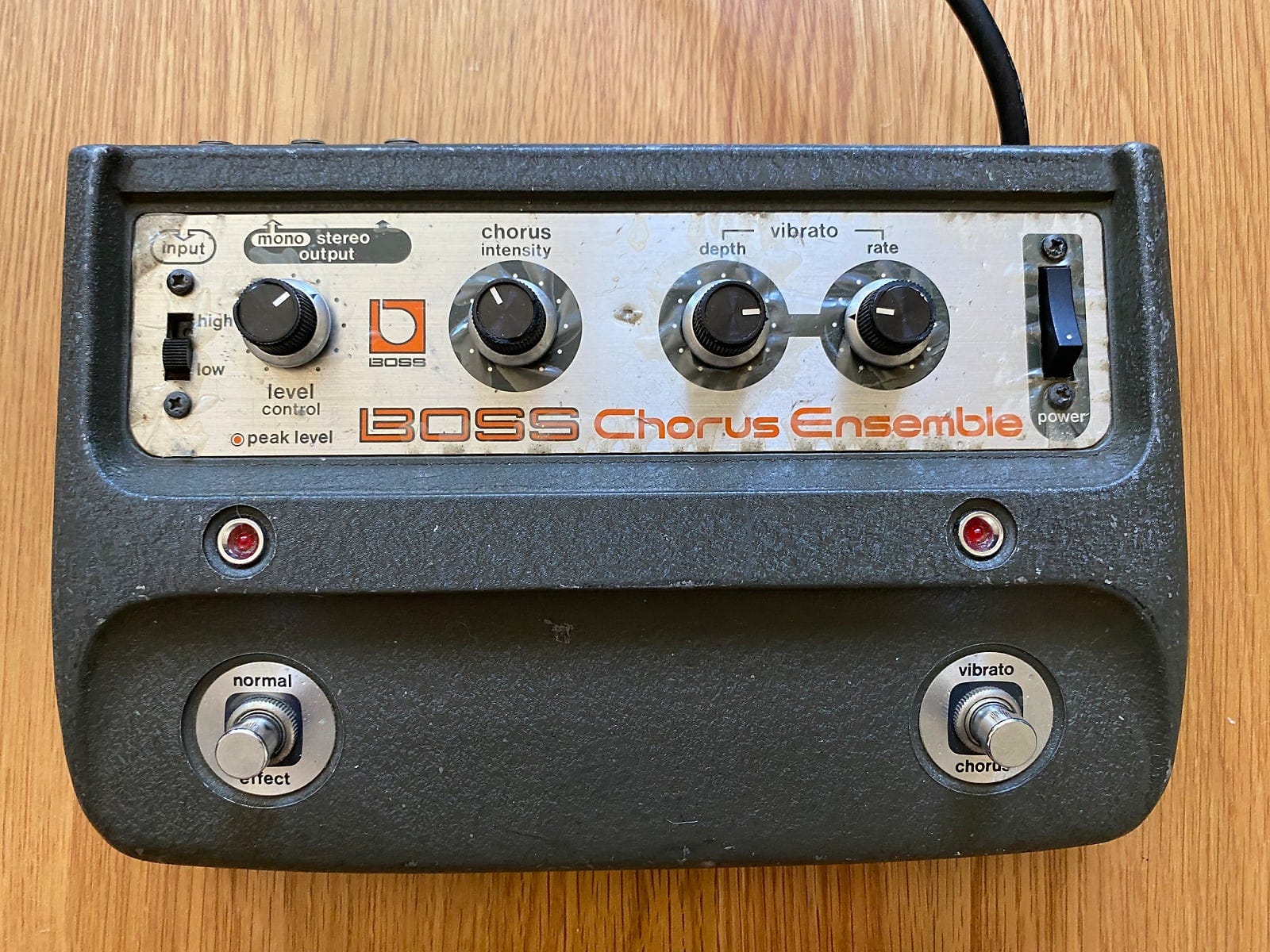
And especially helpful when you’re playing as part of a trio.
Well, exactly. I was always looking for ways to fill things out, because Geddy and Neil were such active players; sometimes, I felt like you needed a grounding in the melody. And that was great for me, because it taught me how to explore chordal structure, and how to get the most out of a note in terms of an ensemble. All those chords that I’ve used over the years were all open, jangly chords just to fill up space [laughs] — and I’m not sure I would have gone that direction if I hadn’t been forced to.
And the Boss chorus, combined with those jangly open chords, really widened up the sound.
Exactly.
Would you use it on your solos, as well?
Sometimes I would, but not often. It all depended on the song, and what the context was for the solo. I never wanted to do a solo just to do a flashy solo; I wanted it to be an integral part of the song, that would relate to the whole song. Sometimes a chordal sort of solo, like in “Distant Early Warning,” that was all chorus-y; the chorus was on through the whole song, so in my mind it suited it to keep it all intact.
Were there specific settings that you used that really worked with your playing?
You know, primarily I would use one setting, though I recall a tour where I had two units, where one was set to the tremolo and one was set to the chorus. Later on, I got a TC Electronics 1210 — the Spatial Expander, I think they called it. But it had a really great chorus to it, very broad. And when I went to rack-mounted gear, I started using those for the chorus effect, and they sounded great. I would have one chorus set to a sweeping, phasing sound — like, a slower rate, like a phaser, and the other was set to a moderate chorusing effect. Generally, I would say I was around 70 percent wide, and just a touch of Rate, just to give it that movement with very little regeneration.
What about the Electro-Harmonix Electric Mistress? I know there are some pretty iconic Alex Lifeson moments involving that pedal…
Anything that I wanted to create with phasing or flanging, I would use the Electric Mistress. I had a couple of Electric Mistress pedals that I had reconfigured in a rack mount with a few other effects — basically took the guts out of the units and put them in a rack mount. And it had a Maestro Parametric Filter… It was cool, because back in those days, nobody made rack-mounted effects. So this way I could have a whole system and then a backup in my rack, easy to transport and hook up, and all of that junk when you’re on the road. So I basically took the guts out of those units.
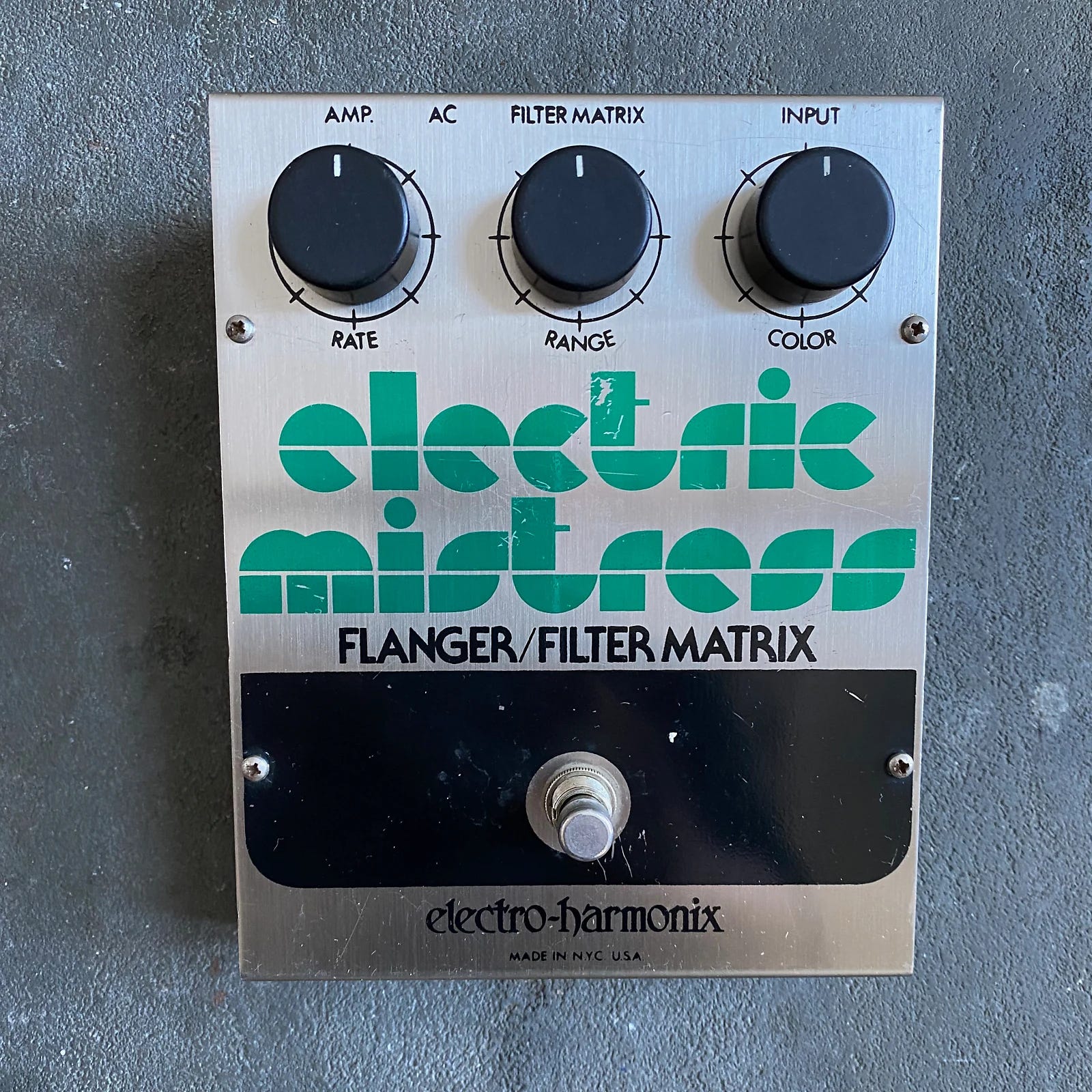
And the Electric Mistress, boy — any time I needed any flanging or phasing, that was the go-to. It was just so profound; I don’t know that there’s ever been anything like it. And it has a particular character, to it; it’s like running a razor through a piece of paper — it has such a smooth cut to the whole tonality of it. And to this day, I still use it a lot. I don’t think it’s my original unit, but it may be one of them. I know I’ve had it for years and years and years.
You know, we have a storage, uh, extravaganza [laughs] where we keep all the gear we’ve ever had. [laughs] We don’t easily give up stuff. So every once in a while, I’ll go to our warehouse, and I’ll go through these cases that are in the back, up on a pallet somewhere, and it’s amazing the stuff that I can find. And that’s where I found that Electric Mistress. So I took that into the studio with a bunch of other pedals. But that’s definitely my go-to.
Is the BOSS CE-1 lost to the ages?
No, I still have the original one! It’s at my studio; all that gear is at the studio that I share with my son. But I still have the original pedal that I started out with.
It’s fantastic that you’ve held on to that!
Yeah, we gave up very little; you’d just put it away and you moved onto the next thing. I wish I’d done that with more of my amps; sadly, I didn’t do that with my Hiwatts and the original Marshall 50-watt head that I absolutely adored. I wish I still had that thing.
Well, pedals are easier to store than Marshall stacks.
Yes, they take up a little less room! [laughs]
Back to the Boss chorus pedal — do you remember where you got it?
Hmmm. No… but I likely would have purchased it here in Canada, so it probably would have been in Toronto, and it probably was at Long & McQuade, which was a big music store that’s been in the city since the early sixties, I think. And that’s the place I used to go to on the weekends when I was a kid; I used to just take a guitar off the wall — an SG or a Les Paul — and play it for an hour until the salesman came by and said, “Get outta here, kid.” I’d go back a week later, play for an hour, and then it would be, “Get outta here, kid.” [laughs] It’s a little bit of a different experience now, going into a music store.
But Long & McQuade, they’ve been around a long, long time; in fact, I just bought some stuff from them last week. I’m pretty sure I would have bought it there, and I would have bought two — I always had a backup. The Electric Mistress most likely, too. At the time, it was a lot tighter between Canada and the US, and you had to be very clear about where you purchased stuff, and where it was on your carnet, and all of that stuff. So because we were Canadian, we had to shop here.
You mean, if you bought gear in the US, there could be customs problems with bringing it back to Canada?
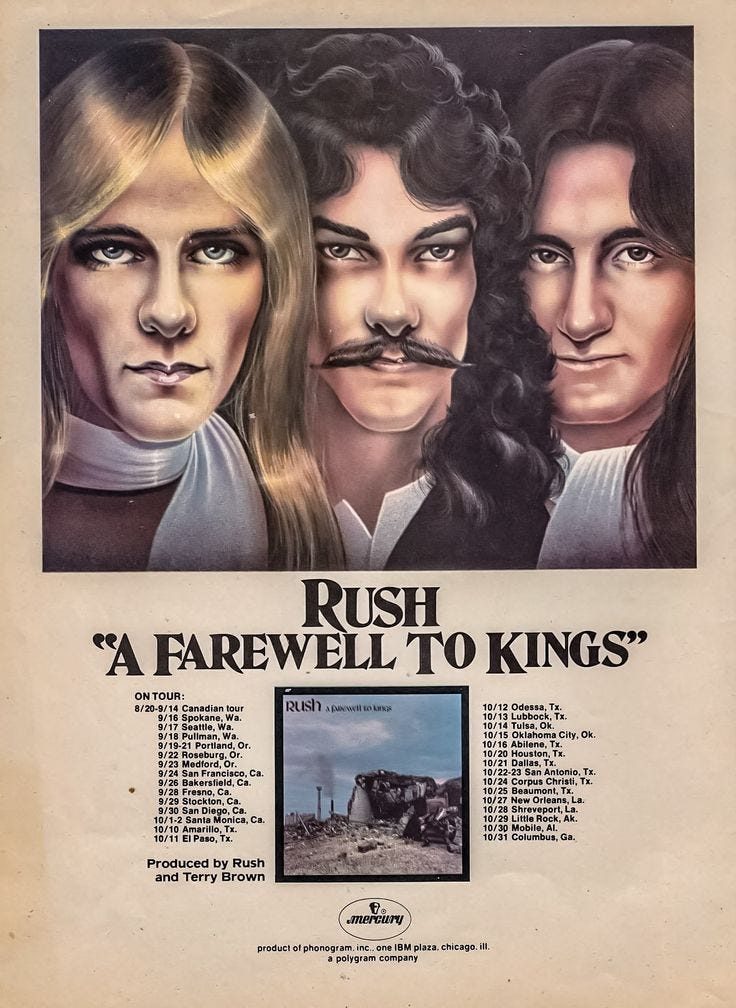
Yeah. There were a couple times where they pulled stuff off the truck and checked numbers… I remember getting a call from the RCMP [Royal Canadian Mounted Police] around that time, on the Farewell to Kings tour. The gear came back from the US, and they actually came to my house about two of my guitars; they wanted to know where they came from and if I’d declared them, because I’d purchased them in the States. [laughs] I mean, now it’s a lot different ever since NAFTA and the more open borders, but then it was very controlled.
I imagine that had to be kind of a stressful and surreal experience, having the police show up to your house to interrogate you about your guitars.
Oh yeah! [laughs] Our equipment had went straight to the shed that we were playing, and because it had gone straight there all the trucks were locked. And I guess they put some sort of seal on it, and they were there for the unlocking of the trucks to make sure that nothing was being smuggled in. [laughs] And they came to my house after that, when they inspected these couple of guitars, which in fact I did buy in the States. I think I had bought a Les Paul in Atlanta, and I think I’d bought my Ramirez acoustic in the States as well…
So yeah, they came to the house. And I remember it was a nice, sunny morning, and they knocked on the door, and it’s the RCMP. And “Hi, we’re with the RCMP!” I’m thinking, “Oh my god, do I have any pot sitting around here?” [laughs] But they were great, though. They came in, and said, “This is what we’re here for, we just want to check, blah blah bah.” And it was done and off they went. I think they did that kind of stuff just to let you know that they were watching.
So… did you have any pot sitting around?
Yeah. [laughs] Thankfully they didn’t notice.
You may also enjoy:


Great interview! Also, I've travelled all over the world and have never faced more scrutiny at a border than when going into Canada so the customs story definitely checks out. I'm picturing the RCMP guitar declarations task force in the big red uniforms but the buttons are shaped like flying-v's
Seeing Alex & Geddy's video yesterday first thing was the best news I've woken up to in ages, the two classiest hosers in Rock! At first I thought maybe they re-animated Rutsey!