
Chris Difford: "I've Got The Easy Part."
Squeeze's word man chimes in on the band's wonderful new album — Trixies — and the various musical and literary figures that influenced his writing


It was Glenn Tilbrook’s golden trumpet of a voice that initially hit me when I first heard Squeeze in the summer of 1980 — “Pulling Mussels (from the Shell)” was the song, which was then getting a fair amount of airplay on New York City’s FM rock stations. But after a few more listens to “Mussels” (and “If I Didn’t Love You” and “Another Nail in My Heart,” both of which also got some regular radio spins that summer), the lyrics began to stand out to me, as well — words which painted vivid (and sometimes pun-bolstered) pictures of an existence that bore little relation to the 24/7 party lifestyle that so many rock stars of the day seemed to celebrate.
Instead of songs about rocking, getting ready to rock, and/or the after-effects of all that rock action, Squeeze were offering eloquent snapshots of low-rent beach vacations, romantic ambivalence and drowning your sorrows at the pub in the wake of a domestic argument. Within the next year, I would fall deeply under the spell of such clever lyricists as Ray Davies, Elvis Costello, Joe Jackson and Graham Parker; but in retrospect, the above three songs from Squeeze’s Argybargy album were what really opened my already-Anglophilic brain up to the charms of three-minute compositions packed with witty wordplay and vivid images of daily British life.
As I would later discover, these lyrics that so impressed me were entirely the work of one Chris Difford. While Rolling Stone hailed Difford and Tilbrook as the John Lennon and Paul McCartney of the British New Wave, it turned out that Squeeze’s founding pair enjoyed a much different division of labor than their fab forebears: Difford played rhythm guitar and wrote all the lyrics, while Tilbrook (whose singing voice combined McCartney’s elasticity with some of Lennon’s nasal twang) played lead guitar and dipped Difford’s tart words in toothsome melodies of his own devising.
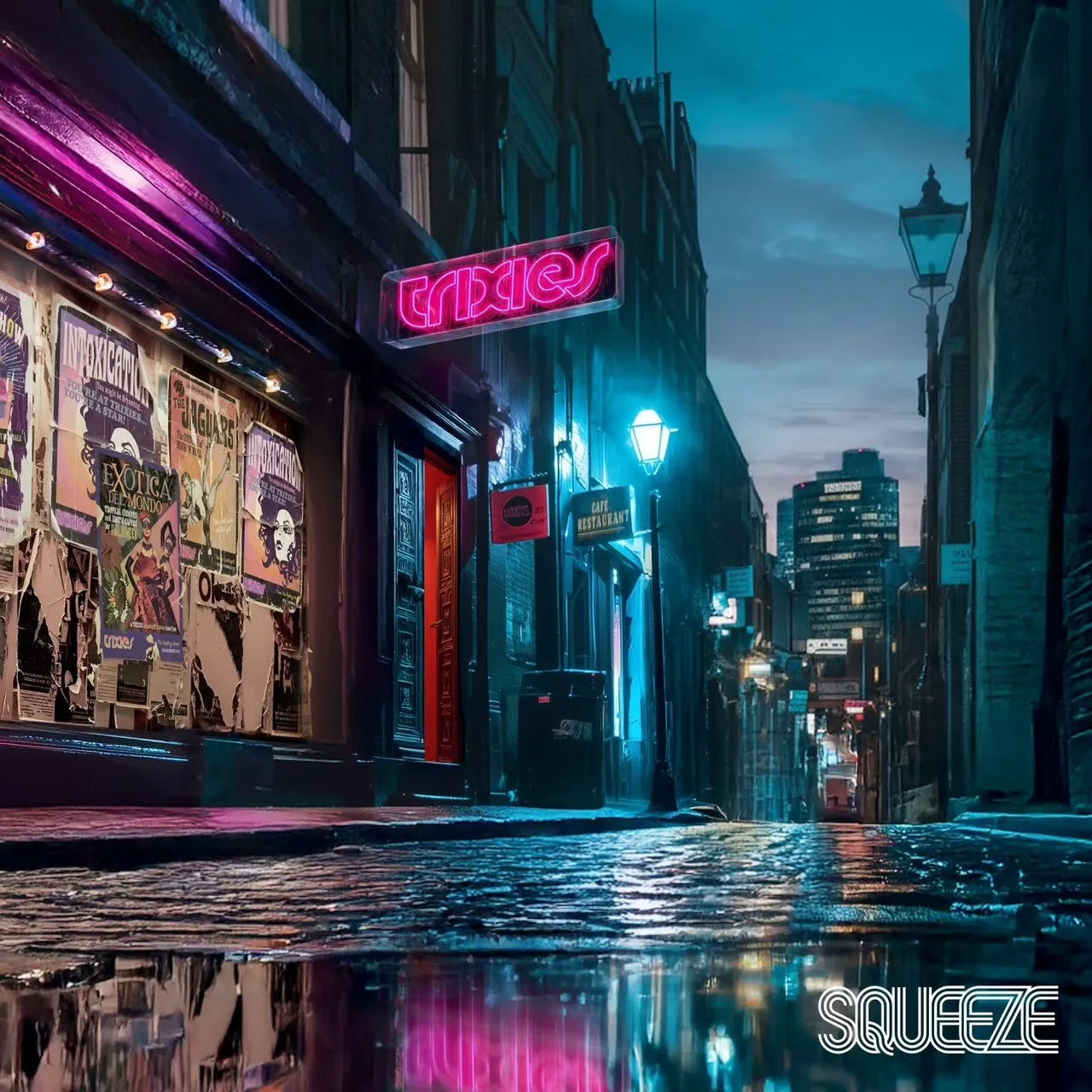
Theirs is an artistic arrangement that — despite some band breakups and personal fallings-out over the decades — has remained pretty much unchanged since 1973, when 16 year-old Tilbrook answered a “Guitarist Wanted” ad tacked up by 19 year-old Difford in the window of a South London sweet shop. Some of the pair’s early songwriting collaborations have recently come to light on Squeeze’s wonderful new album Trixies, which finds the band re-recording a brace of concept-driven, previously-unreleased songs that were originally penned by Difford and Tilbrook back in 1974. Despite the age of the material (and the fact that its musical influences sometimes make themselves a little more obvious than they would be on the duo’s subsequent songs), Trixies slots in remarkably well alongside the rest of Squeeze’s extensive discography, and as such is highly recommended to anyone who loves the band.
I interviewed Difford and Tilbrook separately in February 2026 for a FLOOD magazine piece about the new album and its early-seventies origins. I posted the full Tilbrook interview here at JTL a week and a half ago, and today I’m posting the full Difford chat — and as with said Tilbrook interview, it’s available here in its entirety for my paid subscribers.

If you’d like to read either of these interviews past the paywall, $5 a month (or just $4.17 a month — 14 cents a day! — if you opt for an annual subscription) will get you full access to this and everything else in the JTL interviews archive, along with full access to all the completed chapters of my in-progress “adolescent musical memoir”, and all 31 episodes of the CROSSED CHANNELS podcast that I record on a monthly basis with my friend and colleague Tony Fletcher. Our most recent episode examines how Siouxsie & The Banshees’ 1985 single “Cities in Dust” and its parent 1986 album, Tinderbox gave the legendary UK post-punk band a long-overdue US breakthrough…

So if that sounds good to you — and just FYI, I never, ever use AI to do anything for this Substack — just hit the button below, and follow it to the choice of subscription options. And if you’re already a paid subscriber of Jagged Time Lapse, you have my undying gratitude; thanks for helping me keep the lights on amid this ever-darkening journalistic landscape…
Chris Difford and Glenn Tilbrook are two very different people, and some of those differences were glaringly apparent when I rang up the former a day or three after I’d interviewed the latter. While Mr. Tilbrook seemed quite open and friendly from the get-go, Mr. Difford came across as a little bit shy and much more reserved, like someone who has never entirely gotten comfortable with the idea that people would want to ask him questions about his songs. That said, he had some incredibly interesting things to share with me about Trixies, as well as his own literary influences and his long-running songwriting partnership with Tilbrook. And as a Squeeze fan of some 46 years now, it was a real thrill for me to chat with him…
Chris, Trixies has such a strange and wonderful story behind it. Perhaps we can just jump into where it all started.
Well, it started as a teenager, really. I had no idea what I was doing; I just wrote a lot of lyrics, and they all seemed to fit together, really. I’d been influenced by Raymond Chandler and Damon Runyon’s storytelling, and it just seemed like a great idea to write about a particular nightclub that would be very dangerous place to go, but also quite a sexy place. And I’d never been to a nightclub, so I just imagined what it would be like — and it ended up being Trixies.
Trixies conjures up images for me of the sort of seedy English nightclubs that Michael Caine would hang out at in Get Carter, or something like that. But this was not actually from your own experience?
No, I hadn’t been to a nightclub. But I’d been dabbling in musical theater and musical soundtracks. It was quite prevalent at that point that people were doing like rock operas, like Tommy and Quadrophenia, and it seemed like a good idea to have a kind of concept record, or a concept amount of lyrics, because you could keep the focus and the ambition tightly locked within one storyline. And I wanted to dabble into that and see how it would work.