
JTL Flashback: Kris Kristofferson Was My Babysitter
A fond farewell to a childhood companion

Greetings, Jagged Time Lapsers!
I’m currently on the final laps of a book-editing project, so I unfortunately had no time this weekend to concoct something new and tasty for your Monday eyes. It was also my mother’s birthday yesterday, which I think should qualify as a no-work holiday in any civilized society.
Like The Intruders once sang, I’ll always love my mama — but sometimes I still find myself staggered by a sense of awe with regards to the massive amount of musical influence she’s had on my life. Not only via the records she played around the house when I was a little kid (more on that in a second), but because of all the time we spent listening to the car radio together — including our local country station during our early-seventies commutes to nursery school and kindergarten, and mid-seventies AM pop stations during our summer drives around Los Angeles — and talking about the music and artists we heard.
My mom was always interested in the records I brought home as a teenager; if she often hilariously mangled the song lyrics she overheard coming out of my room, she nevertheless usually found something to enjoy about the music. (The only album she really didn’t jibe with was the first Van Halen album, which she politely requested that I play only on occasions when she wasn’t around.) I certainly owe a lot to my father, too — but my decision (if you can even call it that) to follow a music-related path through life was undoubtedly the direct result of my early musical bonding with my mom.
Kris Kristofferson was (and remains) one of her favorites, so I’m dedicating this re-post — which I originally wrote back in October 2024, a few days after he died — to her. Happy Birthday, Mom!
Sometimes, when I’m having trouble falling back to sleep after my cat Angus has impatiently drummed me awake at 4 a.m. to dole out breakfast for him and his brother Hugo, I’ll close my eyes and take a mental stroll through some of the many houses and apartments I’ve lived in over the decades.
One of my favorite places to go back to is the old three-story house on Ann Arbor’s Morton Avenue, which my folks rented from 1969 to 1974. That five-year span was the longest I lived in any domicile before reaching my thirties, so maybe it’s no wonder that I can still call it all up in fairly vivid detail. It was also the site of a lot of happy, formative times for me between the ages of three and eight — none happier or more formative in some ways than the hours I spent on the living room floor drawing pictures, reading MAD magazine and various DC comics (and/or books on the American Revolution, Civil War and both World Wars), and listening to whatever records the adults in the house happened to be spinning at the time.
Music wasn’t a main interest for me back then — I don’t recall ever asking to hear a specific record or song — but it wasn’t just background noise, either. I was acutely aware that certain melodies could stir deep emotions in my young soul, even if I had no real ability to articulate what I was feeling or why I was feeling it. And I always listened to the words, paying close attention to the pictures that they painted. Adult-oriented lyrics perked my ears up from very early on (at least once I got past my “Yellow Submarine”/”Puff the Magic Dragon” phase), because I somehow understood that they offered a window into the workings of the grown-up world, a world I was both fascinated with and extremely mystified by.
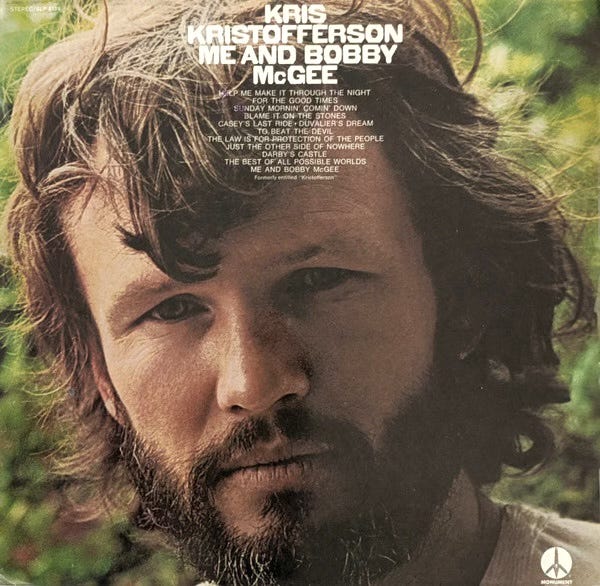
My mom was a huge Kris Kristofferson fan, as were most of her hippie friends, so he was a pretty constant presence in our house. And I use the word “presence” advisedly, because every time someone played his albums Jesus Was a Capricorn, The The Silver Tongued Devil and I, and especially Me and Bobby McGee — the retitled repackaging of his eponymous 1970 debut, re-released in 1971 after Janis Joplin scored a posthumous hit with the title track (and yes, I just committed the rock critic faux pas of using “eponymous” and “posthumous” in the same sentence) — it felt like he was right there in the living room with me.
I never got that same feeling from Bob Dylan’s Nashville Skyline, or the first two Band LPs, Arlo Guthrie’s Alice’s Restaurant, Simon & Garfunkel’s Bridge Over Troubled Water, Carole King’s Tapestry, or the Grateful Dead’s Workingman’s Dead, to name some of the other albums in regular house rotation at the time, even though I definitely responded to them all in one way or another. But Kristofferson’s records seemed to beam him directly into our house, and I liked listening to the stories he had to tell, even if I didn’t necessarily understand them or the personal travails that inspired their creation. He seemed tired and cranky, but also dryly funny, and most of all real; I could easily imagine him looking over my shoulder at my new drawing or my latest copy of Mad, and offering up a wry but encouraging comment on the subject. (Little did I know at the time that he could have also had some insightful things to say about my military history books.)
Unlike many of my music industry pals and colleagues, I never knew or even met Kris Kristofferson, and I can’t say I roll particularly deep with any of his albums past, say, 1974’s Spooky Lady’s Sideshow. But losing him this week still felt like losing a member of my extended family, if only because he was with me in our living room so often between nursery school and second grade that he may as well have been babysitting me and my sister. Though two years younger than me, my sister responded to his music, as well; I vividly remember her referring to “Blame It On The Stones” as “Climb All Over the Stone,” and asking my mom to play it again.
My dear friend Erik Sugg wrote something on Facebook yesterday that really rang true for me, and I don’t think he’ll mind me reprinting it here:
One of the many things I always loved about Kris Kristofferson, in addition to his amazing music and his acting talents, was that he turned the whole notion of “masculinity” upside down... He had grit but he also had vulnerability. He lived a life without fear and otherizing, and he possessed a beautiful openness towards others.
I think that’s largely true. I suspect Kristofferson did live with some degree of fear, especially during his days as a struggling songwriter, when his family disowned him and his first marriage was falling apart; but if that’s the case, he seems to have turned that terror inward for motivation, rather than using it as an excuse to act out against other humans or punch down with his songs. But after reading Erik’s words, I found myself wondering if that same combination of grit, vulnerability and an intrinsic sense of fairness — which he famously exhibited while supporting Sinead O’Connor during her controversial appearance at the 1992 Bob Dylan tribute concert at Madison Square Garden — wasn’t something I instinctively sensed from the get-go, and a big part of why his voice and presence felt so welcome and attractive to me during my early youth.
I think about the three most important men in my life — my dad, my Grandpa Fred and my Uncle John — none of whom fully conformed to stereotypical American notions/restrictions of “masculinity,” but all of whom made me feel safe and appreciated as a child. Kristofferson conveyed the same comforting warmth, intelligence and playfulness that the three of them possessed, and maybe that’s why I always liked having him around.
It also may be why his singing voice always sounded perfectly fine to me. Obviously, the man himself would have told you that he was no Enrico Caruso, nor even a Johnny Cash; but I remember being shocked and confused in my teens when I opened up my copy of Christgau’s Record Guide and read Robert Christgau’s assessment of Kristofferson’s singing on his debut album:
He’s the worst singer I’ve ever heard. It's not that he’s off key — he has no relation to key. He also has no phrasing, no dynamics, no energy, no authority, no dramatic ability, and no control of the top two-thirds of his six-note range.
I mean, that’s a tad wide of the mark, innit? Even coming from the man who once called Jimi Hendrix “a psychedelic Uncle Tom”…
No, Kristofferson wasn’t the most artful or refined singer to ever caress a microphone, but his low-pitched rasp and matter-of-fact delivery was part of what gave his songs their considerable gravitas. Much as I enjoy and admire, say, Al Green’s rendition of “For the Good Times” or Janis’s hit version of “Me and Bobby McGee,” I’ll take Kristofferson’s recordings of these and all his other oft-covered songs over them — even Johnny Cash’s megalithic reading of “Sunday Mornin’ Comin’ Down” — because Kristofferson’s songs never sounded as rich, complex or as thoroughly lived-in as when he sang them himself.
Kristofferson lived a long, complex and incredibly rich existence, of course, and this Guardian obit by Adam Sweeting hits the high and low points of it so I don’t have to do it here. I was already well aware of most of what Sweeting mentions — Kristofferson’s Rhodes scholarship, his military career, his film career, his alcoholism, his proud left-wing political stance — but one plot point which completely took me by surprise was the revelation that, while attending Oxford in the late 1950s, Kristofferson tried to get a singing career going with the assistance of British “beat svengali” Larry Parnes.
A flamboyantly gay impresario, Parnes already had a stable of handsome young pop idols like Billy Fury, Marty Wilde, Tommy Steele, Vince Eager, Duffy Power and Johnny Gentle on his managerial roster, all of whom he had renamed (or so went the popular rumor at the time) to reflect their performances in bed. Dubbing him “Kris Carson” — an alias which alas doesn’t particularly align with the aforementioned rumor — Parnes secured Kristofferson some recording sessions with eminent British pop producer Tony Hatch, but nothing came of them.
These recordings have never resurfaced, at least to the best of my knowledge, but they were probably ghastly. Kristofferson’s untutored voice worked wonderfully within the context of his own songs and the earthy production of his early albums, but I can’t imagine it sounding anything but jarringly wrong when cosseted in the claustrophobically sweet production styles favored by the British music biz in the pre-Beatles era…
Not that Kristofferson fared particularly well when he returned to the UK in 1970 for a gig at the Isle of Wight Festival. To be fair, the festival — as demonstrated in the amazing 1995 documentary Message to Love — was already a total shitshow by the time he and his band (which included former Lovin’ Spoonful axeman Zal Yanovsky) took the stage; and even if it had been a far less unruly affair, the festival’s flimsy sound system would not have been up to the task of conveying the subtleties of Kristofferson’s songs to the overflow crowd.
But I love this clip from the doc all the same, and laugh every time Kristofferson — not yet the bearded and confident country-hippie adonis he’d transform into in just a year’s time — gazes out at the audience with a mixture of bemusement and “I’ve seen some shit before, but not like this” trepidation, clearly wondering what the hell he’s doing there. “I think they’re gonna shoot us,” he deadpans to his bandmates, before finally bailing out altogether…
Thankfully, this being the UK, no one did shoot them — and Kris Kristofferson went on to live, write, record and act for the bulk of the next half-century and change. As I’m sure is the case with many folks right now, his passing makes me want to go back and explore some of his albums that I missed, as well as rewatch Cisco Pike and some of his other excellent screen performances.
But mostly, I just want to go back to that living room on Morton Avenue, and hear him sing to me about broken romances, hangovers, Sunday mornings, mysterious women and deeply flawed men while I put the finishing touches on yet another drawing of a WWI dogfight.
Rest in Power, Kris. Thanks for the good times — and for “For the Good Times,” while we’re at it.
You may also groove on the following:


Thanks for this. You brought me back to an earlier time in my life also.
Thank you Dan. At first I couldn’t think of anything more chilling than for a kid to hear the doorbell ring on Morton and be told “oh that must be the babysitter”. Then in strides Kris Kristofferson with him booming voice and downward gaze. “WTF?” you might have thought but dare not have said.
Then enveloped in his warmth and tenderness you’d know it was OK and he ask about your drawings.
The last time I saw him perform was on the PBS celebration of Willie Nelson’s 90th birthday. By then he was all vulnerability. He could barely walk, forgot lyrics, needed help from Cheryl Crow? to finish the song—but he sang. And the twinkle in his eyes remained.
On a very different note unless it was ironically intentional it’s ”faux pas” not “faux pax”. AI strikes again.
“Faux pax” is what there is in Gaza.