
RIP, Phil Campbell, Part Two: "We Didn't Write For No Record Companies!"
Motörhead's last and longest-running guitarist told it like it was in this 2021 interview

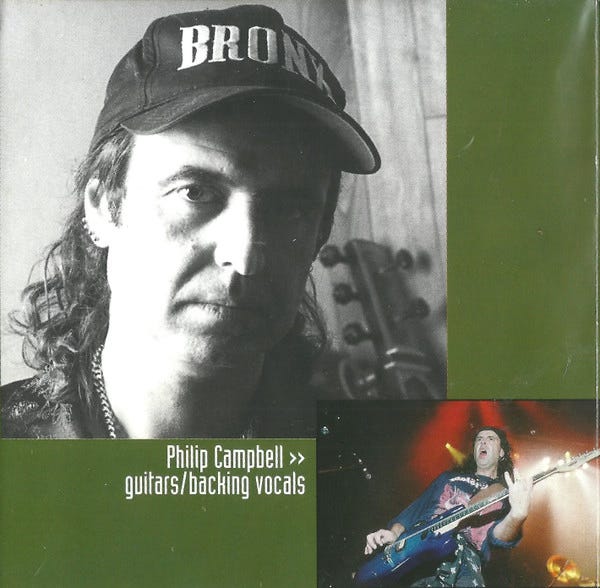
I was so saddened by the recent news of Phil Campbell’s untimely passing. The man was a true rock n’ roll lifer, and at 64 it seemed like he had a lot more life and music still left in him. Plus, he just seemed like a thoroughly decent bloke.
Campell’s passion for playing — and for the 31 years he spent as Motörhead’s guitarist — came through loud and clear in an interview I did with him in 2021. The chat was occasioned by a special Motörhead issue published by Revolver magazine, for which I was penning a 12,000-word history of the groundbreaking, earthquaking British band. The project involved talking to a number of folks who knew and worked with Lemmy Kilmister over the years, and one of my favorite interviews of the lot was the one I did with Campbell, the longest-serving member of the band outside of Lemmy himself. We spoke for over an hour for the piece, and he seemed like he would have been more than happy to talk for another hour or two if his schedule had permitted.
As often happens with these sort of interviews, only a few choice quotes made their way into the feature, and I wound up sharing my complete Phil Campbell interview with my paid Jagged Time Lapse subscribers back in 2023, as I often do with my favorite musician interviews. But in honor of the man’s passing, I’m re-sharing both parts so that everyone can enjoy them.
In Part One, re-published here last week, our topics included Phil first meeting Lemmy when the latter was still Hawkwind’s bassist and the former was just an 12 year-old fan, how Phil came to join Motörhead a decade later, and why he and Lemmy were so bitterly disappointed with 1986’s Orgasmatron LP.

Here in Part Two, we cover former King Diamond drummer Mikkey Dee’s entrance to the band, the departure of Phil’s longtime guitar partner Würzel, Motörhead’s ongoing difficulties with record companies, Phil’s penchant for playing pranks while on tour, what kind of music Lemmy generally liked to listen to on the tour bus (hint: it wasn’t punk or metal), Motörhead’s enduring legacy, and so much more. Read on, preferably with a Motörhead record blasting in the background. In the words of Phil Campbell, “If everyone could just put a bit of Motörhead on, now and again, that’d be really cool.”
Mikkey Dee initially came in to help you guys finish up the sessions for 1992’s March ör Die, then officially joined the band for that tour. What made you realize that he was the right guy for the drummer position?
Well, me and Lem, we remembered him from King Diamond. They us supported us in 1985 or ’86 or something like that. And Mikkey was a spectacular drummer then. I think Lem managed to get a hold of him because he was with Dokken at the time, but I don't think Dokken were doing much. Mikkey came over to Musicgrinder Studios up on Hollywood Boulevard, and he fitted in great. The worse his hangover was, the greater he would play! [laughs] At the soundcheck he’d be like, “Oh, my head feels like shit!” and then he’d come on and be incredible. But that was great when we got together with him, yeah, and it stuck for so many years.
Mikkey was a much showier player with King Diamond and Dokken, but he found a way to dial it down with Motörhead while still retaining the personality of his playing.
Yeah, he knew how to slip in some bits that we wouldn't have necessarily thought of — a little three-four timing or something just a little bit different — because he was used to a lot of technical stuff as well. But also, Mikkey can slam out the straight beat like no one. But we all had the same vision of what we wanted the band to sound like, and we knew it was pointless trying to stray off that too much. We’d do the odd one or two acoustic songs and things like that, but we didn't wanna change the band’s sound or direction, really.
It was a unique thing, but Mickey fitted in great. And the sense of humor he had as well with the three of us, it was remarkable — we had the best time imaginable, really. [laughs] We’d have a great laugh all day, and our gigs were incredible. We very, very rarely had a bad gig; I can count them on like one hand, probably.
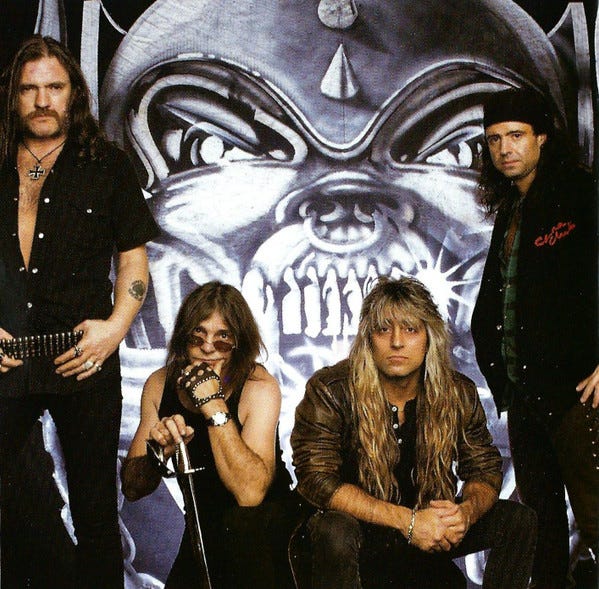
We used to live in different countries — Mik was living in Sweden, Lem was in LA, and I was in Wales — but when it came to do an album and things, it'd be about three or four months writing, rehearsing and then recording. So I'd be back over to LA for four or five months, you know, and Mik as well. But on tour, you’re doing gigs night after night, and we'd be sleeping quite a bit in a day, but we'd still go out. Well, I'd go to museums now and again, and Lem and I would go see some shops or things like that. We hung out quite a bit.
Yeah, the impression I always had was that you guys genuinely enjoyed each other's company.
Sometimes we could irritate each other — I probably was the most guilty of that, but they were usually like, “That’s Phil, just let him be.” Like, Mikkey used to come back on a weekend; it'd be all nice and quiet on a bus or, you know, fairly quiet, and Mik would come back with a bunch of usually male strangers [laughs], all drunk and Swedish. Wherever we were, he’d find the Swedes, then come back and turn the stereo on full blast on the tour bus and start blasting out Journey. Nothing wrong with Journey, like, but if I hear “Separate Ways” one more time, I’m gonna fucking go mental! [laughs] But we thought, “Well, that’s just Mik being Mik!”
What would “Phil being Phil” usually entail?
Oh, playing pranks all over people, stink bombing them, or dressing up, fabricating information to ‘em, different things. [laughs] You know, there was a lot of time to kill, after you woke up on the bus or at the hotel. Me, I would start drinking immediately, and then it was like, “All right, we’re not leaving for the gig for the next three hours — what can I get up to?” I was nuts, really.
Why did Würzel leave the band in 1995?
I dunno if he was missing being home a lot… or I don't think he was overly keen on Lem residing in the US, cuz he was quite proud of Motörhead being a British band. But that might not be the case at all. I just remember we was somewhere in Glendale, working with Howard Benson on the Sacrifice album. Würzel was doing a solo, and he had two or three goes at the solo and it wasn't happening. Which is nothing, you know; I would spend days on bloody solos and end up going with the first one I did. But all of a sudden he just said, “Fuck this,” and just threw his guitar down and walked out of the studio. No, actually, he took his guitar with him as well. [laughs] I didn't have a guitar with me that day. so I had to go and drive down to our storage in Hollywood and grab another…
Yeah, I really don't know. But he wasn't happy for some time. And that was a shame, because Würzel was a fantastic guy, a unique guitar player. He used to do some incredible leads and thrash the hell out of that guitar, and he was another one with an incredible sense of humor. So I was very sad as well, but you can't make people stay in the band if they’re not happy. You can't force anyone to do anything, really. There’s no point in that.
Did you guys consider finding someone to replace him? Or did you immediately decide to soldier on as a three-piece?
Well, almost straight away I said, “Look, boys — I think I can do this by myself. So let's have some rehearsals; and believe me, if it’s not happening, I'll be the first one to say we should get someone else in as well.” But we played three or four songs, and it was just apparent to everyone that it would work like that.
Which must have made things a little more efficient, at least in terms of making records.
Yeah, and with the live sound as well, because the volume was so loud anyway, and there’s one less guitar to worry about in the mix. I know it sounds silly to use the word “clear” in the same sentence as “Motörhead,” but I think the sound possibly was a little bit clearer as a three piece. And mixing was a bit simpler that way in the studio. So, it sort of all helps.
But then I had to work and do my practice out of hours a lot, because I had to basically come up with nearly all the riffs to start to get a song started off, you know? So in my apartment out there, I'd have an amp and I'd be playing for five or six hours whenever I was back from the studio; I'd be like playing the same riff for hours and hours, trying to get it better or change it a little bit. And as time went on, it did get more difficult to come up with original riffs; we still managed it, but it got hard because there's so much in the past, and we all wanted to keep it in the Motörhead vision, you know. So you just gotta dig a little bit deeper, ’cuz Würzel came out with some brilliant riffs when he was with the band.
“On Your Feet Or On Your Knees” — that was a great riff of Würzel’s, and there was a load of good ‘uns like that. So I missed him that way, as well as being a great bloke to have around. I really missed him contributing. “Just ‘Cos You Got the Power,” I think he came up with that one, too. We were both taking a piss somewhere in the studio and he said, “Oh I think I got this riff, it’s just come into my head now!” We finished up our piss, and he went back and picked up a guitar and then he played it. [laughs]
The inspirational magic of the urinal!
Yeah, good thing he didn’t need a shit — he probably would have forgotten it by the time we got back to recording. [laughs]
You guys had a lot of difficulties with record companies through the years. I know Lemmy could be rather bitter about that, at times. Was he mostly the one dealing with that side of things, or did you all get involved?
No, we all got involved. I mean, when we recorded Bastards, we recorded it for ZYX — which was a German dance label — purely for the fact that they offered us a lot more money than any other record company. I was the one that kicked the chair from under the record company boss.
Wait — you did what?
He came to see us and there’s only three of us in the band, right? He’s speaking to us about the album in the dressing room, and he looks at me and calls me Mikkey. I mean, there’s only three names to fuckin’ learn. And this guy was big, he was about like 300 pounds, you know? And I probably had a few drinks by then. So I got up, I kicked the chair from out from under him, and he fell flat on his ass. I said, “What chance have you got of selling our records? You don't even know the three band members’ names! Piss off!” [laughs]
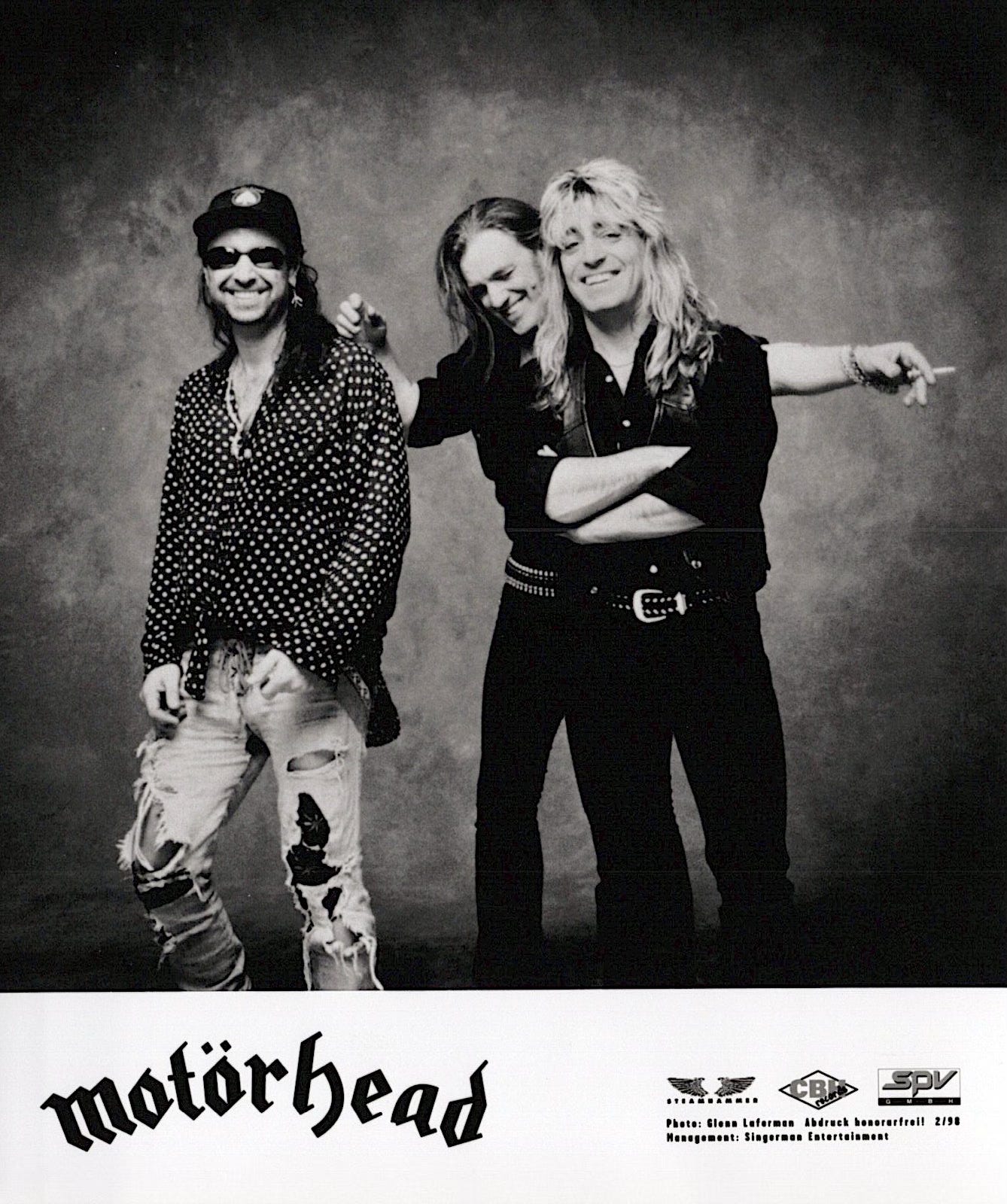
But we got a good manager in Todd Singerman. Todd approached us in our early days in LA, and he's still looking after everything for us now. Todd would do all the fighting for us. He really fights for his artists, like Peter Grant used to fight for Led Zeppelin; he would do everything possible to see that his artists didn’t get ripped off. So that was a good thing. We had good representation, for once.
Cameron Webb told me that Lemmy’s health issues first became apparent back in 2013, when you guys were working on Aftershock. What do you remember about that?
I knew he wasn’t the Lem that I met in 1984, but everyone gets older. So you kind of put it down to that, really. And Lem did amazing, actually, to do what he did right up until the end. Because we all said, “Lem, if you don't feel well enough to go on this tour…” And he always said, “No, no, I want to do it.” He was a trooper, you know, but it was still pretty sad; he did go downhill a little bit quick at the end. [Note: Motörhead played their final concert on December 11, 2015; Lemmy passed away 17 days later from a combination of cancer, cardiac arrhythmia and congestive heart failure.] But he still wanted to record and play. And if that’s what he wanted, we were there for him.
Cameron said that 2015’s Bad Magic, your last studio album, was done much differently than your other records — that Lemmy just wanted to jam in the studio with you guys.
Yeah. That's probably the first time we thought we'd just write in a studio instead of spending six, eight weeks in a rehearsal room writing songs. We thought we'd come up with ideas in the studio and then get ’em down on tape; that, you know, it might be a bit simpler. And Lem did great, as well; it was another great album. [He pauses for a few seconds.] It’s really difficult to talk about it, like; he did so well, you know, but it was so sad to see him deteriorate at very end.
Ultimately, how would you describe Motörhead’s legacy?
I'd like to think that our legacy is that we made a lot of people happy with the music. That would be really nice, you know? So many people have come up to us all over the years and said, “Your music, your songs, or this song got me through a really bad point in my life,” you know. But the music is there to be celebrated, as well. You take out of the music whatever you want; there's a lot of killer songs there, and the band, we really meant it. When we wrote the songs, we wrote the songs for us; we didn't write for no record companies. You’re getting the real deal there. So I’d just like to be appreciated for that, you know?
We didn't sell the most records ever in the world, millions and millions of records, but we worked our asses off, doing gigs and traveling and, you know, trying to write the best songs and play the best that we could together. And it was a great time doing it. So if everyone could just put a bit of Motörhead on, now and again, that’d be really cool.
What’s one of your favorite memories of Lemmy?
Oh, Christ, I knew this was coming… well, I didn’t actually, but fucking hell, let me think… [laughs] I just loved riding in the back of the bus, just the two of us, listening to the Eagles, singing the harmonies together, and marveling over the lead vocals and the arrangements. And we used to play Skunk Anansie, and a bit of ABBA and ELO and Dave Edmunds. I used to be listen to a lot of music with him in the back of the bus, just the two of us. That was pretty cool. We was really close.
I don’t think a lot of people realize how varied Lemmy’s musical tastes were. I remember hanging out at his apartment in West Hollywood, listening to Dave Edmunds’ early band Love Sculpture. Some people would probably have difficulty believing that he was into The Eagles or ABBA or ELO, but you saw it firsthand.
Yeah, I was right there. And his right boot — the rock and roll boot — would be there tapping the beat. If Lemmy was awake, that boot would be tapping away! [laughs] Was that the apartment on Harratt Street?
It was, indeed.
Lemmy didn’t drive, so I was the one who would have to pick him up on our way to rehearsal or to the studio. I used to come from the Valley and pick him up at that apartment on Harratt Street. One day I went to pick him up, and he buzzes me in, and says, “Come on and sit down a minute, Phil; I’m not ready.” He was very rarely ready; he’d still be in his underpants, or whatever. So we were getting ready to go, and — you saw the apartment, it was pretty messy, right?
Oh god, yeah. I remember he had to move a big stack of books, magazines and faxes off the couch so I would have a place to sit.
Oh no, I know. “Don’t sit there — that’s a dagger from blah blah…” It was like fucking playing Twister, wasn’t it? [laughs] So anyway, I finally got him ready to go, and we were about to go out to the car, and he couldn’t find his fucking apartment keys, could he? We spent like an hour looking for them, with no luck; we finally had to cancel the rehearsal. [laughs]
But I know what you mean; there was never any way to lounge out and get comfortable on that couch. There was always just enough room to sit there with your knees pressed together, or maybe move a few inches in either direction. The thing was, it was good quality stuff he had all around that apartment; it was all really interesting. Everything he had in it was brilliant!
Just his collection of military memorabilia alone was pretty mind-blowing, but then he had that collection of cowboy boots, too, and it was all wedged into this tiny one-bedroom apartment.
Whatever you can think of, he had a collection — medals, boots, guitars, books, everything. And he was always, “Don’t sit on that! Don’t sit there!” [laughs] We finally got him into a new apartment; he had a really nice apartment the last couple of years, just down the road. I think Slash gave him a pinball machine for it; he had a couple of different pinball machines in different rooms, and everything was super nice. But he kept the one on Harratt Street for his storage, thank god. [laughs] Harratt Street is quite the legendary apartment, that; I still have the gate code implanted on my brain!


Very cool. Great clip choice, Mikkey is a monster. I've been to the Rainbow a few times since I moved back, pretty much the same except for the vibe, it's become more of a bucket list tourist spot of intrigue more so than a sleazy rock joint from the folks I've seen in there - the pizza is still great. Ever see this Würzel clip? https://www.youtube.com/watch?v=7uVb_R_Rcpw
Love every single bit of this!