
Don't Give It Up Now
Flashing back on my introduction to On Fyre, Lyres' classic 1984 debut

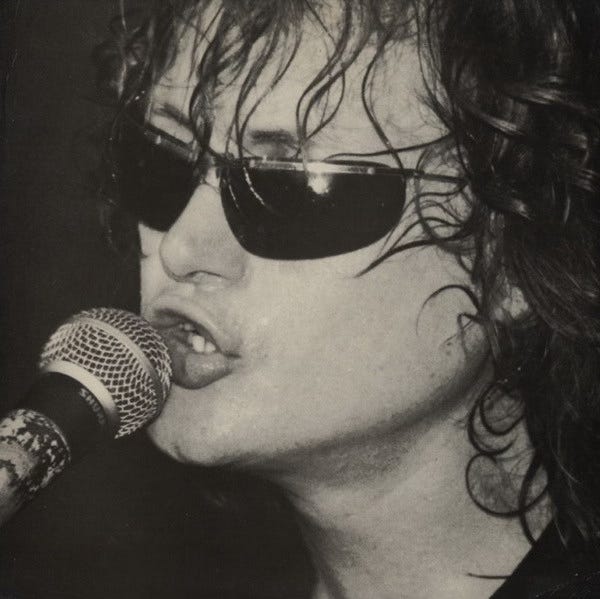
Jeff “Monoman” Conolly, the leader and lone constant of long-running Boston garage rock kings Lyres, died of cancer last week at the far-too-young age of 69.
It’s possible that many Jagged Time Lapse readers have never heard of Conolly or heard his band, which would be a damned shame… but also entirely understandable. Lyres (no “The,” by Jeff’s decree) never had anything close to a real, Billboard-anointed hit. None of their extensive discography was ever released on a major label, or even on an independent one with reliable distribution. They never received much in the way of national press outside of their arguable peak in the mid-eighties. And — aside from the placement of “Help You Ann” in the third season of the FX series Rescue Me — none of their songs were ever featured on the soundtrack of a major TV show or motion picture.
All of which says far more about the inherent lack of musical taste within the American entertainment industry than it does about the intrinsic worth of Conolly and his band. Because at their best, Lyres were one of the mightiest rock n’ roll combos to ever stalk a stage, and Monoman was a dynamite frontman and rock n’ roll evangelist of the highest order.
Given the music-savvy social circles (both online and real-life) that I’ve run in over the years, it hasn’t been at all surprising to see my Facebook and Instagram timelines overflowing with heartfelt tributes to Conolly and his music. It was equally unsurprising to see words like “challenging” and “difficult” appear in these reminiscences, even from folks who he’d allowed to see his softer, kinder side. Because “Monoman” — a nickname inspired by his religiously-held belief that monophonic music always sounded better than stereo, at least where real rock n’ roll was concerned — had a well-earned reputation for being ornery, abrasive, complicated, ferociously opinionated and rather tough to get along with. (Wikipedia lists Lyres as having contained 23 different members besides Conolly over the years; I’d wager that the actual number is considerably higher.) But the massive respect that Conolly engendered over the years as a musician, songwriter, performer and garage rock expert was equally well-earned.
“I had various interactions with the guy for almost 40 years, and I never had one interaction where he wasn’t a complete jerk or an asshole to me,” wrote ace guitarist and guitar historian Deke Dickerson in one such FB post. “It became such a comical routine that before meeting him face-to-face again, we would make bets on what terrible, insulting, Jerk store-outcome of the conversation was going to be.”
Of course, Deke followed this with, “Monoman was one of the all-time great rock ‘n’ roll frontmen. Throughout his career, he made some of my favorite music of all time, and he never failed to deliver the goods. He was a loud, boisterous, genuine and unique rock ‘n’ roll maniac, and when they made him, they broke the mold.”
I never met the (mono) man myself, never had the “pleasure” of interviewing him or even interacting with him on social media (where his innate venomousness was usually set on “full blast”), and I only ever got to see a couple of killer Lyres shows in the mid/late-eighties. But I can say without a doubt that Jeff Conolly — or at least On Fyre, Lyres’ first album — totally changed my life, and I am forever grateful to him for it.
Not only can I still vividly remember the day I first heard that seminal album, but I can even recall the day I first heard about it — such was the momentousness of my discovery. It was about midway through the July of 1984, and I was just settling into my summer gig as an office assistant in the law department of a major corporation, a job which would eventually extend through the following summer as I counted down the days of my unplanned “gap year” between high school and college. After a few weeks in the position (which had been kindly bestowed upon me by the corporation’s general consul, who also happened to be the father of a good friend), I’d determined that there often wasn’t actually that much for me to do on a day-to-day basis, and that I could get away with reading books or magazines on the job so long as I looked busy.
On this particular summer afternoon, I was paging through the newly-released September ‘84 issue of Musician magazine, which I’d placed surreptitiously in the opened top drawer of my desk; anyone glancing into my tiny office as they passed would simply assume that I was studiously concentrating on the small mountain of paperwork piled in front of me, instead of reading interviews with rock stars. I was also eating a Hostess chocolate cupcake, which — back in the days when I weighed about 120 pounds — seemed like a perfectly reasonable choice for an afternoon snack. I had just taken a chocolatey, cream-filled chomp out of it when I turned the page to the magazine’s “Short Takes” reviews section, written by J.D. Considine.
“Short Takes” was where the magazine generally stuck reviews of new records that were deemed too oddball, obscure, uncommercial or unexciting to warrant more extensive critical assessment. (It was also where Considine occasionally got to flex his arch wit — a la his infamous 1986 review of GTR’s album, which simply read “SHT.”) And there, sandwiched between capsule reviews of The Cure’s The Top and the debut album from David Knopfler (the estranged brother of Dire Straits’ Mark), sat Considine’s brief summation of On Fyre:
“There’s nothing new in the Nuggets-like grit of these ten tunes, and that’s as it should be. The Lyres are garage band classicists who understand that form is function, and who know how to make the most of an 8-bar guitar break or organ rave-up. And best of all, they lack chops in exactly the right places.”
The breadth of my musical knowledge and appreciation would expand exponentially over the coming months, thanks to having extra cash in my pocket and working within a five-to-ten-minute walk of several good-to-great record stores and bookstores in downtown Chicago. But as of July 1984, I knew just barely enough about music and music history to glean from Considine’s words that On Fyre was something I should keep an eye out for.
At this point, I still hadn’t actually heard Nuggets, the legendary Lenny Kaye-produced compilation of 1960s garage rock greats, but I’d read enough about it in places like CREEM to surmise that the music contained within was raw and wild and weird in ways that were entirely alien and antithetical to the overly polished pop and rock of the mid-eighties. Depressed by the over-produced recent releases of longtime heroes like Bruce Springsteen, Elvis Costello, Joe Jackson, The Cars and former Squeeze leaders Difford & Tilbrook, I had begun to actively search for new, guitar-driven bands that were pushing the envelope away from the aspirational sheen of the Reagan era. But since mainstream music mags currently formed the bulk of my educational reading, and I couldn’t pick up any of the local college stations from my bedroom, I hadn’t yet managed to hit upon anything much wilder than R.E.M. or The Bangles. But if Lyres actually played garage rock with “Nuggets-like grit” and “organ rave-ups,” then perhaps they’d be just what the doctor ordered…
I retrospect, it’s pretty funny that I found out about Lyres via Musician, a good but fairly conservative mag that tended to focus on established artists known for their proficiency as players or songwriters, and which in those days was typically crammed with ads for synthesizers, electronic drums and digital multi-effects units — things that were all total anathema to Jeff Conolly’s staunchly lo-fi vision.
But its especially funny that I first read about Lyres in the back of the magazine’s “Heavy Metal Special” issue, an issue whose entire raison d’être seems to have been an editorial meeting where one of the higher-ups remarked, “Oh shit — Quiet Riot and Twisted Sister are huge, Scorpions and Judas Priest recently had hit albums, and we get a lot of advertising from pointy-guitar companies like Carvin and Ibanez. Guess we’d probably better do something on metal, huh?”
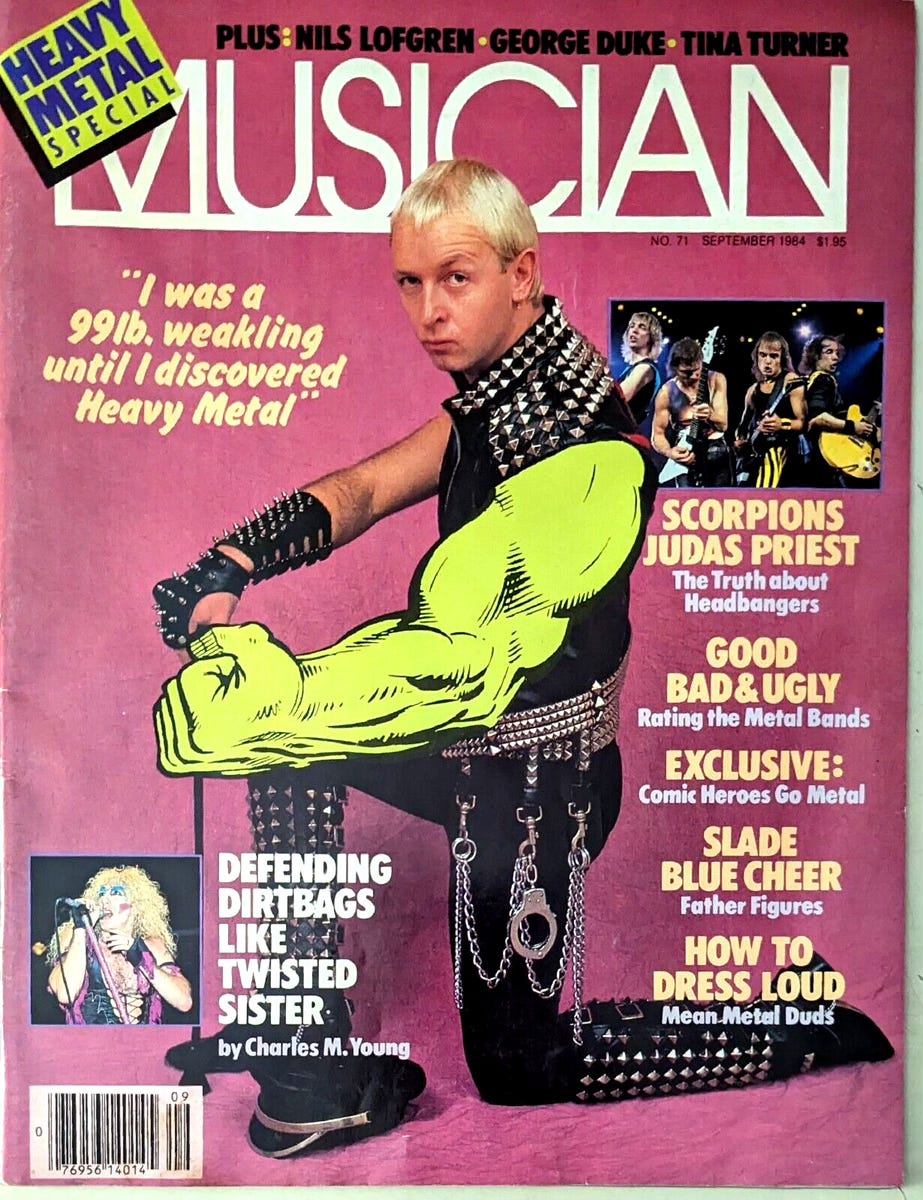
Even back in 1984, I found that issue’s metal content to be condescending at best, and at worst painfully ignorant. (Iron Maiden topped the issue’s list of “Ten Worst Heavy Metal Bands”, while Jefferson Starship — yep, you read that right — was listed at #7.) Paging through it today, you can practically hear the giant exhale of relief among the magazine’s staff once the coverage switches back to old favorites like Nils Lofgren and George Duke. I have no idea if he actually saw this issue, which reflected a galaxy far, far away from Lyres’ universe, but Conolly would have almost certainly hated everything in it save for Considine’s On Fyre review. (Though, given his reputation, he probably would’ve found reason to hate that, too.)
But if the Musician review initially piqued my interest, it was Ira Robbins’ review of the record in that same month’s issue of Record — Rolling Stone’s short-lived sister publication, which was intended to focus exclusively on music at a time when Jann Wenner had pivoted to lodge his storied publication firmly in Hollywood’s ass — that really sealed my determination to grab a copy of On Fyre.
In addition to name-checking The Seeds’ deliciously snotty “Pushin’ Too Hard” (which I’d heard several times on various oldies radio shows) and the 13th Floor Elevators “You’re Gonna Miss Me” (which I hadn’t yet found a way to hear, but knew that it was regarded by many as thee greatest garage rock anthem of the 1960s), Robbins mentioned that the album contained “the reedy sounds of Farfisa organ and fuzzed-out guitar” — and, best of all, covers of two songs by my favorite band in the world, The Kinks. Sold!
Armed with that pertinent info and a crisp new ten-dollar bill, I excitedly headed over to Rose Records on my next free lunch hour. Rolling Stone Records was just around the corner from my office, but they mostly stocked major label releases; Rose’s buyer was much more aggressive about bringing in new albums from independent and underground imprints. (I would pick up my first Hüsker Dü album, Zen Arcade, there later that fall.)
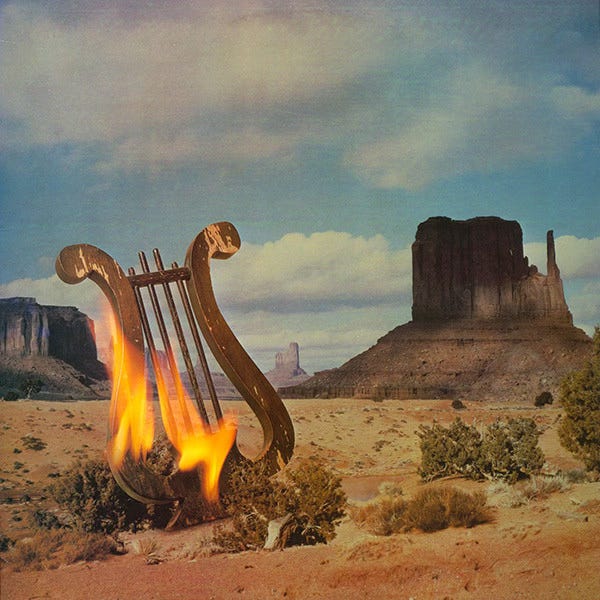
I went upstairs to the store’s second floor, where they kept the indie and import stuff, and started flipping excitedly through the “L” section. And lo, there it was — On Fyre, with its gloriously lurid cover image of a burning lyre standing amid the tumbleweeds of Monument Valley!
Ah, but not so fast.
“That’s a cool record,” said a voice to my left. “But if you like garage stuff, you should really check out the Chesterfield Kings.”
This unsolicited advice came from a Rose employee I’d encountered a few times before — a pudgy, red-bearded guy who always tried to start up a conversation whenever we crossed paths in the store. In retrospect, I kind of wish that I’d been more receptive to his attempts to alert me to cool shit, since his was the polar opposite of stereotypical “record store snob” behavior. But at the time, I was just a stubborn little fucker on a self-propelled quest to learn as much as I could about music without actually seeking or taking advice from any human being who didn’t already have a byline in a major US or UK music publication.
(This was, admittedly, a strange and potentially self-defeating approach to exploring music, since I personally knew only six people at the time whose musical expertise seemed substantial enough to consult, and four of them would soon be away at college. But I had self-imposed rules, dammit, and I was going to live by them.)
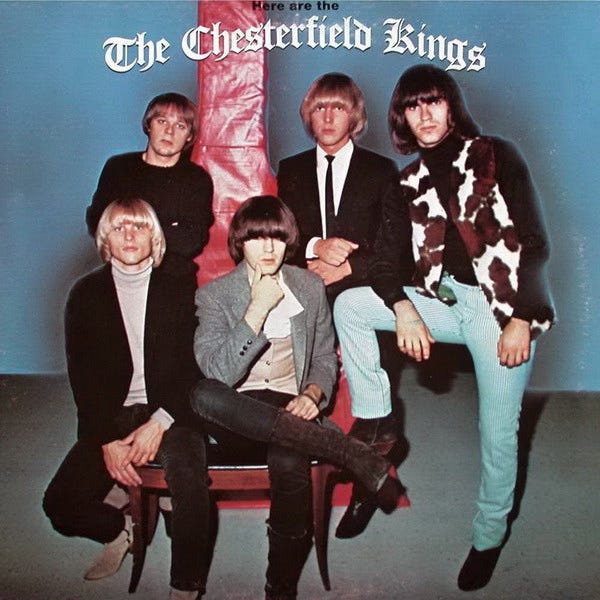
I aimed a non-committal grunt in the direction of the Rose employee, and looked over at Here Are The Chesterfield Kings, the album he had pulled out to show me.
“They do covers of songs by bands like the Sonics and the Chocolate Watchband,” he said, “It’s really awesome.”
That description admittedly sounded intriguing — though I was only familiar with both of the bands he mentioned by their reputations, rather than their actual recordings. But there was just something about their cover photo that seemed overly precious and contrived to me; the five dudes with “pudding bowl” haircuts and pointy boots looked like they were trying way too hard to pretend that it was 1966 all over again.
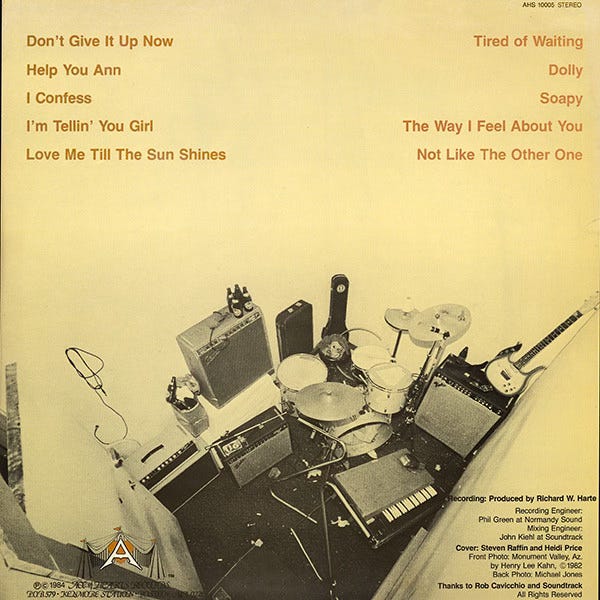
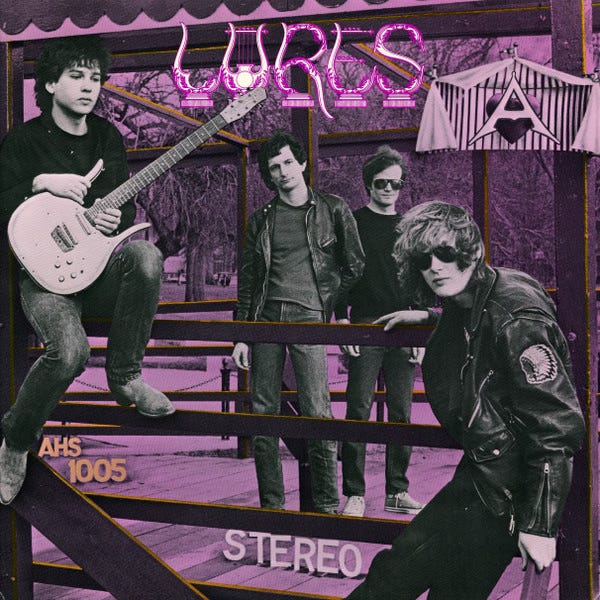
On Fyre, on the other hand, featured no picture of Lyres at all. I had no idea what the band looked like, but I found myself immediately drawn to the sepia-toned back cover photo, which showed a pile of their gear — including a Farfisa organ and what I would later learn was a Danelectro Guitarlin — propped haphazardly in what looked like the storage area of a rehearsal space. The amps and drums were well-worn, and one of the Farfisa’s legs had come loose, forcing the organ (actually a Vox Continental, though at the time I figured any “cheesy” 1960s organ must be a Farfisa) to rest at an awkward slant. One vintage-looking Fender amplifier was topped with empty beer bottles, and bits of garbage lay strewn about the floor. Everything about the photo just telegraphed “hard-gigging, ass-kicking band” to me; here was an outfit that was clearly more interested in rocking than posing. And best of all, none of their equipment looked like anything like the shiny, expensive “state of the art” stuff being advertised in Musician.
If I’d had more money on me that day, I might have left with both albums. (I did dig the Chesterfield Kings album once I finally heard it, though that wouldn’t be for another few years.) But my ten-spot would only cover one of them, and I just had to hear what the band with the black-keyed organ and freaky-looking, long-necked guitar actually sounded like. On Fyre it was, then.
Remember folks, this was 42 years ago. I couldn’t go online to hear a record before I bought it; I couldn’t even go into a store with a CD listening post. I had yet to hear a single note from On Fyre — I was bringing the album home and plopping it on my turntable entirely on the say-so of a couple of music journalists whose knowledge and writing I respected, and who had peppered their reviews with just enough of the right clues and signifiers (including references to records I hadn’t heard but knew were supposed to be cool) to let me know that this record might be in my wheelhouse.
This was just how you had to roll back then. Of course, I’d gotten burned before by putting my trust in the music press, and I would certainly do so again. But almost as soon as I dropped the needle on On Fyre, I knew that the only burning happening was from the fire in my soul as the explosive rock n’ roll blasted from the vinyl.
“Don’t Give It Up Now,” the opening song, faded in like it was being broadcast from another dimension, with the band already cooking at full intensity by the time the track reached full volume. Led by a surfy guitar line, and driven by a firmly held chord from the as-advertised “reedy Farfisa” and a four-chord guitar figure that even a novice guitarist like myself might be able to play, the music immediately caught me in its confident sway. But what really put the song over the top for me was Conolly’s no-bullshit vocal delivery, and the equally frank advice he was dishing out:
Take what you need, don’t ever give it all away
Everybody’s always influencing each other in some kind of way
Won’t be ashamed, won’t ever let people know
‘cause what’s really important is that eventually you’re going to go
Don’t give it up now
Don’t give it up now
Don’t give it up now
Don’t give it up now
At a time in my life where nothing was unfolding like I’d imagined and I was questioning pretty much everything about my identity and existence, “Don’t Give It Up Now” landed on me like comforting, encouraging, dot-connecting advice from a wise older cousin who knew the score. Over the next year, the song would find a place on just about every mix tape I made for friends and for myself; over and over again over the next several decades, it would serve as a musical life raft in stormy times.
I was just barely processing “Don’t Give It Up Now” when a heavily-tremolo’d guitar kicked in with the intro to “Help You Ann,” and I just about lost my freakin’ mind. I didn’t even know guitars could sound like that! Grabbed by the sheer propulsiveness of the track, I actually started dancing around my bedroom, too busy grooving to pay any attention to what Monoman was singing about; this was simply the coolest-sounding music I’d ever heard, and it felt like my brain was being zapped by a cleansing strobe laser — whatever stress and angst was built up in there from my annoying work day and sweltering bus commute had now completely vanished.
You just couldn’t follow a song like “Help You Ann” with something of equal or greater intensity, and Lyres didn’t try; the album’s third track, “I Confess,” was a mid-tempo love song with actual vocal harmonies. But even this one sent my brain into overdrive: It sounded naggingly familiar… and then I realized that it was a cover of a song by 1960s Chicago band the New Colony Six, another track I knew from weekend oldies shows on local radio.
I’d always found the original of “I Confess” charmingly awkward, like it was cut by interstellar aliens trying to impersonate earnest American teen humans, but I’d never even briefly considered that it could possibly be “cool”. But if Lyres were covering the song, it had to be cool, right? And if, by extension, the New Colony Six were cool, then Chicago — a city I’d pretty much stopped thinking of as cool after spending the summer of 1980 in New York City — might actually win some coolness points for producing them, right? My mind was reeling…
If On Fyre had only been a three-song EP, those three songs would have already given me more than my money’s worth of uplifting rock action and breadcrumbs to follow for additional musical discovery. But there were still seven more tracks to go — including three more killer Conolly originals (“I’m Tellin’ You Girl,” “Dolly” and “Not Like The Other One”), attitudinous covers of songs I’d never heard (“Soapy” by Mickey & the Clean Cuts, “The Way I Feel About You” by canned Beatles drummer Pete Best), and raw renditions of The Kinks’ “Love Me Till The Sun Shines” and “Tired of Waiting For You”.
Even though they’d been part of what attracted me to On Fyre in the first place, those Kinks songs were actually the least appealing part of the album for me, at least upon first listen. I appreciated the love for “Love Me Till The Sun Shines,” a Dave Davies track from 1967’s Something Else that I’d always felt was pretty underrated in the Kinks kanon, but Lyres’ Side One-closing version didn’t really add a whole lot to the original. And their reworking of Ray’s “Tired of Waiting For You” that opened Side Two just seemed weird to me, like they were intentionally dragging out the song’s rhythmic emphasis in a way that didn’t quite work. But hey, how could you top The Kinks at their own game?
And really, my first impression of those tracks didn’t matter in the long run — the other stuff on On Fyre was so strong that I kept coming back to it on an almost-daily basis, and eventually I grew to love those Kinks covers nearly as much as everything else on the album…
On Fyre was my first garage rock LP, my official introduction to the Farfisa’d and fuzztoned sonic template that would guide so much of my musical exploration and listening during the next half-decade and beyond. But while I slowly became aware over the next few months that there were many other “garage revival” bands out there besides Lyres and Chesterfield Kings, none of the new garage stuff I heard hit me in the same earthshaking way that On Fyre had; it all just felt painstakingly imitative, and much of it was recorded in ways that actually blunted the music’s force. On Fyre, on the other hand, had boldly staked out an updated (if decidedly un-modernized) vision for garage rock that sounded fresh and almost violently vibrant amid the sanitized sonic landscape of the mid-1980s.
And anyway, why go with self-conscious imitations when you could hear the real thing? By the late fall of 1984, the first volumes of Rhino Records’ new Nuggets series — which used the Kaye comp as a jumping-off point — began appearing in the bins of local record stores, making it clear to me that I needed to go straight to the source material for my kicks. Rhino’s Nuggets eventually led me to AIP’s Pebbles, and by the summer of ‘86 I was spending most of my record money in the “oldies” section of Chicago’s fabled Wax Trax Records, which was the best place in town to find sixties garage comps and reissues. All of which would play a substantial role in my weekly college radio show “Peace, Love and Fuzztone,” which made its debut in the late fall of 1986 with a playlist that leaned heavily on the Seeds, Sonics, New Colony Six, Barbarians, Electric Prunes and other such Nuggets-approved acts.
My Lyres fandom had admittedly cooled somewhat by then, both because I’d met many Boston kids at school who had nothing but shit to talk about Monoman, and because the band’s second album, 1986’s Lyres Lyres, didn’t immediately put me in a life-changing headlock the way On Fyre had. Of course, if I’d paid closer attention to their new album, it would have put me hot on the trail of such sixties worthies as The Pretty Things, The Alarm Clocks and Dutch band The Outsiders, all of which were covered therein; instead, it took me another year or so to get to the Pretties on my own, and I wouldn’t hear the other two bands until the nineties. Monoman was trying to show me the way, but I was too wrapped up in the vintage sounds that he’d originally pointed me towards to pay attention.
Nevertheless, I owed him — and owe him still — for setting me on course to discover all manner of Farfisa’d and fuzzed-out delights. It’s a trail I’m still following to this day to some extent, even if those Lyres-inspired discoveries eventually sent me off onto several other divergent and equally alluring trails. And I will forever love On Fyre, not just for its blistering music and cocky swagger, but for the way it shook me from my Summer of ‘84 stupor, and kept me forging determinedly ahead at a time when nothing but music made sense to me.
Thanks for all that, Monoman. May you rest in fuzz.
You may also groove on the following…


Thanks for writing my thoughts down. Except I was in Boston not Chicago. And I shopped at Newbury Comics, where I bought the On Fire vinyl and devoured it just as you did. Had the pleasure of seeing the madness at the Rat many times from 1985-1988, when I lived there. His savage reputation came through live, and that anger was spewed back at him via the audience, between dancing and collisions. It was a beautiful thing, changed my life too, and found a way to torch our souls. So glad we had him for those moments, forever in his debt.
Hi Dan, wow did that album make an impression on you! As you know, I spent a lot of time in Boston in the second half of the 1980s, and successfully pitched various Boston-related features for UK mags, which meant, inevitably, I interviewed Jeff. At his home. And I hate to burst peoples' bubbles, but he was great fun. Energetic enough that I later wondered if he was speeding, but perfectly pleasant, I had no bad memories of it all. (Sometimes us UK crits get the favorable treatment.) But here's what I really remember, and it also flies in the face of your summation of his 'lo-fi' reputation, at the end of the interview we'd been talking about The Who and he wanted to play me something from his collection. And it was a hell of a collection he had, also.
Yes, I guess chances are it was mono, and whether it was The Who Sell Out so we could salivate about an individual song or some 7" single he was enthused over, he had one of those incredibly expensive turntables the likes of which I had never actually seen before. The kind that has so many weights and measures that you wonder if it belongs to NASA. The type that takes up its own entire space on a countertop where nothing else is allowed to come close to it. I certainly wasn't allowed to touch it. And, as you might have done so yourself, I was left to ponder about this person operating at the margins of North AMerican indie music, a total 60s garage rock obsessive who could not be making money from his music but nonetheless had decided that a turntable of this quality was everybit as important as a decent guitar.
I presume somewhere I have the manuscript of the interview, but primarily I just wanted to share this memory. Good to have a good one! RIP Monoman.