

When my impossibly handsome cat Oscar passed away this past November, I started going through all the pics I’d taken of him during the 11 years or so we spent together. (He spent the last three years of his life in the loving care of my ex-wife, who made sure to update me regularly on his shenanigans.)
In doing so, I discovered that I had taken dozens of photos of Oscar enjoying various albums with me — usually from his perch atop my turntable, where he could really dig the vibrations as the record spun.
I’ve decided to use these pics as the basis for “Oscar’s Picks,” a semi-regular series of posts which will be a nice way to keep his handsome memory alive, as well a prompt to write about some of my favorite records. I previously wrote about his epic handsome-off with the cover of Tom Jones’ 1970 album TOM; this time, we’re flashing back on a woefully underrated seventies power pop album…
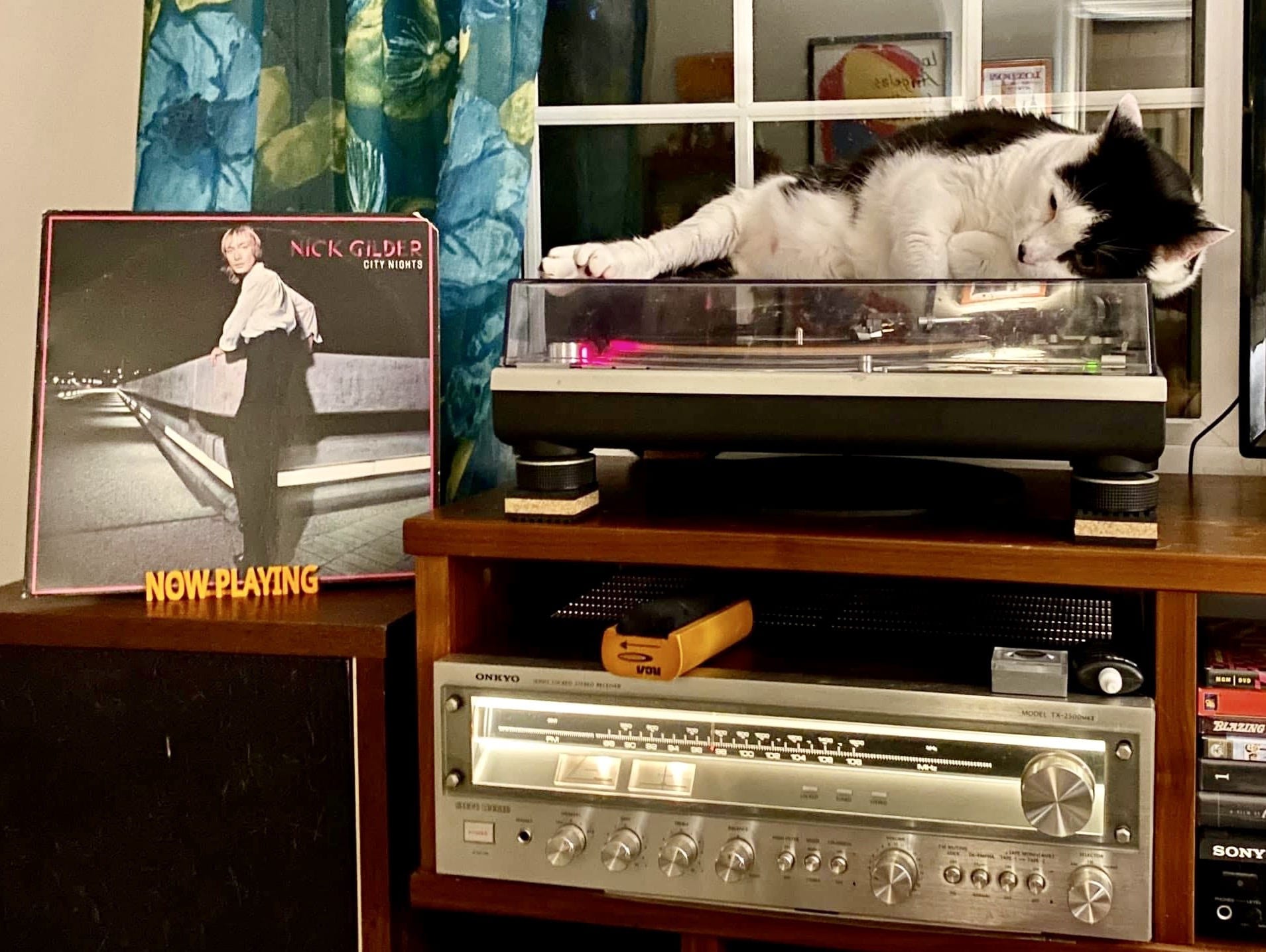
On the left in the above pic: City Nights, the woefully underrated 1978 slab of (mostly) power pop excellence by English-Canadian rocker Nick Gilder, which featured his number one hit “Hot Child in the City”.
On the right: My late cat Oscar, digging said album’s vibrations on a cool spring evening in 2021.
You may be surprised to learn that Oscar and Nick had a connection that went much deeper than just this adorable photo op…
But first, let’s go back, way back, to the summer of ‘78, when “Hot Child in the City,” — released that June by Chrysalis Records — spent 21 weeks gradually sashaying its way to the top of the Billboard Hot 100, setting a record for the slowest ascendance of any single to Number One. The song was all over Los Angeles radio that summer; even KRLA, the station I listened to mostly for its oldies-heavy programming, worked it into regular rotation, alongside other massive hits of the moment like Donna Summer’s “Last Dance,” The Rolling Stones’ “Miss You” and various tracks from the Grease soundtrack.
I didn’t hate “Hot Child in the City,” but I didn’t exactly love it, either. Mostly, I was kind of puzzled by the androgynous quality of the singer’s voice (“Is that a guy or a girl?”) and the similarities between the song’s main guitar lick and the one in Exile’s “Kiss You All Over,” another big hit from that summer. Even my Aunt Geri’s unsolicited observation that “This song is about a teenage prostitute” did little to enhance my “Hot Child” appreciation.
I purchased a handful of records that summer at Tower Sunset, including what would be the first of many Beach Boys albums, but Gilder’s hit was never even briefly in the running for my pre-teen dollars. When I returned to Ann Arbor that fall, for what would turn out be the most miserable semester of my entire academic career, I occasionally heard “Hot Child” on one of the Detroit-area stations, and it would bring back happier memories from the summer. Other than that, the song meant little to me.
The following summer, while staying with my grandparents in Tuscaloosa, Alabama, I heard a song on the local rock station that I initially mistook for Queen, thanks to its distorted and harmonized lead guitars and gang-vocal chorus with the word “Rock” in it. But the third time I heard it, the DJ back-announced it. “Thet wuz ‘You Really Rock Me’ bah Nick Geelder,” he drawled. Wow, the same guy who did “Hot Child in the City”? I was intrigued… but by the time I made it back to L.A. (where I was now living) at the end of the summer, the song had already fallen off the charts — having peaked at a dismal #57 — and out of my memory.
Fifteen more years passed before I gave Nick Gilder any kind of serious thought. During the summer of 1994, I was working at the L.A. Reader as an assistant to the independent weekly’s music and film editors — my first full-time journalism gig — and I’d begun to bond with Erik Himmelsbach, the paper’s editor-in-chief, over our mutual love of 1970s power pop.
“You’ve gotta check out Nick Gilder’s City Nights,” he told me. “‘Hot Child in the City’?” I asked, the skepticism fully audible in my voice, as if my quizzically raised eyebrow wasn’t enough. “It’s the weakest song on there,” he replied. “I’ll tape it for you.”
A cassette duly appeared on my desk the following week, with City Nights on the A-side and Emitt Rhodes’ 1971 LP Mirror on the other. In time, I would come to love Mirror even more than I already loved Rhodes’ self-titled 1970 solo debut; but for now, I couldn’t get enough of City Nights. The first three tracks hooked me immediately — “Got to Get Out,” with its sleazily-inverted “Day Tripper” riff; the tender power pop power-ballad “We’ll Work It Out”; and the glam-tastic, playfully gender-bending “(She’s) One of the Boys”. The fourth track, “All Because of Love,” was kind of bleh, but Side One closed with a longer (and better) version of “Hot Child” than the one I’d heard on the radio, this featuring a dramatic guitar coda which somehow immeasurably classed up the whole enterprise.
Much to my further surprise, Side Two of City Nights was nearly as strong as its first. “Frustration” was, like “Got to Get Out,” a thumping anthem for disaffected teenagers that sounded like it could have been a raw outtake from Cheap Trick’s Heaven Tonight. “Here Comes the Night,” which had come close to scraping the US Top 40 but went to #21 in Canada, was a charmingly slinky (and devastatingly catchy) disco-pop come-on. “21st Century,” the theatrical following track, was likewise hooky as hell and sounded like a close cousin to Sweet’s “Love is Like Oxygen” — which made a bit of sense, given that City Nights was produced by Mike Chapman, who had co-helmed and co-produced several of Sweet’s earlier hits. (And who, I would learn much later, had also co-written and co-produced Exile’s “Kiss You All Over”. Hmmm…)
“Fly High,” a contemplative AOR ballad that broke into a “Hot Child”-style mid-tempo boogie chorus, was my least favorite track on the side; but as with “All Because of Love” on Side One, its pedestrian quality made the songs around it shine that much brighter. “Rockaway” — a strangely enchanting jumble of disco, glam, AOR rock and power pop moves — brought the album to a perfect close, and left me wanting to immediately rewind the tape and hear the whole thing all over again.
I couldn’t believe how great City Nights really was. It had more hooks than the proverbial bait shop, all polished to an alluring new wave sheen by Mike Chapman. (Parallel Lines, by Gilder’s Chrysalis labelmates Blondie, would be the producer’s next project.) With their big choruses and ringing guitar chords, Gilder’s songs — all of which were co-written with James McCulloch, a guitarist whose flair for melodic solos more than made up for his lack of flash — largely straddled the line between glam rock and power pop, with an extra helping of Hollywood sleaze.
While the bulk of his lyrics were concerned the questionable nocturnal urban doings of teenage girls who were growing up way too fast, Gilder’s fey, high-pitched delivery kept the songs from seeming anywhere near as creepy as they might have if sung by lustier-lunged vocalists like Mick Jagger or Paul Rodgers. Yes, the situations in many of his songs were indeed sleazy, but Gilder himself came off as more of a sympathetic observer.
I had to know more about Nick Gilder; and this being that time in the cultural transition to CDs and the internet when online information was scarce but vinyl was cheap and plentiful, I did most of my research in the used bins of local record stores like Aron’s and Record Surplus. I soon discovered two other Gilder albums that were almost as strong as City Nights — 1977’s You Know Who You Are and 1979’s Frequency, the latter of which reunited me with “(You Really) Rock Me” after all those years — and a couple of later records that unfortunately weren’t so hot. I also discovered the first album by Canadian glam band Sweeney Todd, which Gilder and McCulloch had been members of before splitting off to seek gold on their own. (Gilder’s leaving opened up the lead vocal slot in Sweeney Todd, which would eventually be filled by a talented 16 year-old named Bryan Adams.)
This was also around the time when AOL chat rooms were proliferating, and I soon made my way to a “Power Pop” one that was inhabited largely by members and fans of the then-vibrant L.A. pop scene — bands like Wondermints, the Negro Problem, Velouria, the Sugarplastic, the Jigsaw Seen, etc. Among the chat room’s regular denizens was Robbie Rist, best known to seventies pop culture obsessives as Cousin Oliver from The Brady Bunch, but who had since grown up to be a ferociously talented (and opinionated) musician.
Robbie was playing in a bunch of bands at the time, including his own band Wonderboy. Though we had never actually crossed paths in person, we quickly bonded in the chat room over our mutual love of Nick Gilder. “If you ever want to put a Nick Gilder tribute band together, just say the word,” I told him. “But we have to do the album version of ‘Hot Child in the City’!” He called my bluff, and within a month St. Nick (as we dubbed the band) was formed with Robbie on vocals and guitar, me on lead guitar and backing vocals, Roy Lansdown on bass, and Jim Laspesa on drums.
St. Nick played maybe seven or eight shows between the fall of 1996 and the spring of 1997. It was never meant to be a long-running thing — I mean, it’s not like there was much of a demand in L.A. (or anywhere else) at the time for a Nick Gilder tribute band. But those gigs were a ton of fun, and we felt like we’d accomplished our mission, which was to alert the world (or at least the L.A. pop scene) to the fact that the Gilder song catalog went much deeper than “Hot Child in the City”. Which we always included in our sets, of course; but the raucous “(You Really) Rock Me” was invariably our set-closer.
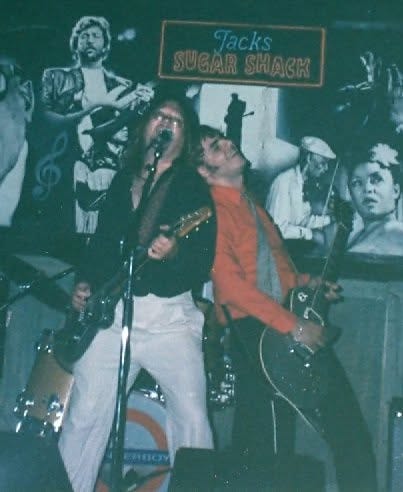
But if this quite-possibly-quixotic endeavor wasn’t meant to go on forever, at least I got lovely friendships with both Jim and Robbie out of it. And in early 2011, when Robbie posted on Facebook that he’d found an awesome cat in his neighborhood who needed a home, I immediately knew that — ten months since the passing of my last cat — this was my sign from the heavens to adopt a new feline friend. Robbie, knowing of my love for cats and how well I’d treated my previous ones, was more than happy to make the introduction. And just like that, Oscar (named for both Oscar Madison of The Odd Couple and the supremely fro-tastic 1970s outfielder Oscar Gamble) moved into my Echo Park bachelor pad…
Ten years later, while Oscar and I (and two additional felines, Otis and Angus a.k.a Tiny) were living in Greensboro, North Carolina with my then-wife, I decided to give myself a birthday treat by upgrading my rapidly-deteriorating stereo system with a mint late-seventies Onkyo receiver and a sweet pair of early-seventies EPI speakers. Once hauled home and set up, I gave them a test-drive using several of my favorite-sounding LPs from the mid-to-late seventies, including the first Boston album, The Best of Spinners (gotta love that Thom Bell production!), Marvin Gaye’s I Want You, Chic’s Risqué, and ELO’s A New Word Record. But it was only once I put on City Nights that Oscar actually hopped up onto my turntable and made himself comfortable.
Maybe he instinctively understood the connection between the album — which, like You Know Who You Are and Frequency, remains frustratingly unavailable on American streaming services — and the cushy life he enjoyed as my and his mama’s “Number One Son”. Or maybe he just dug the music. Either way, it seemed exactly right for Oscar to rock away the night like that.


You were in a band with Robbie Rist?!? (mind blown emoji)
I love that album. Bought it at the same time I bought The Cars' debut. Gilder got more turntable time, even though I love The Cars. Was fortunate enough to see Gilder and his sh*t-hot band touring that album at The Cains in Tulsa. They delivered. Oscar had great taste.