
Oscar's Picks: Physical Graffiti
The handsomest cat that ever was and one of the greatest Side Threes ever waxed

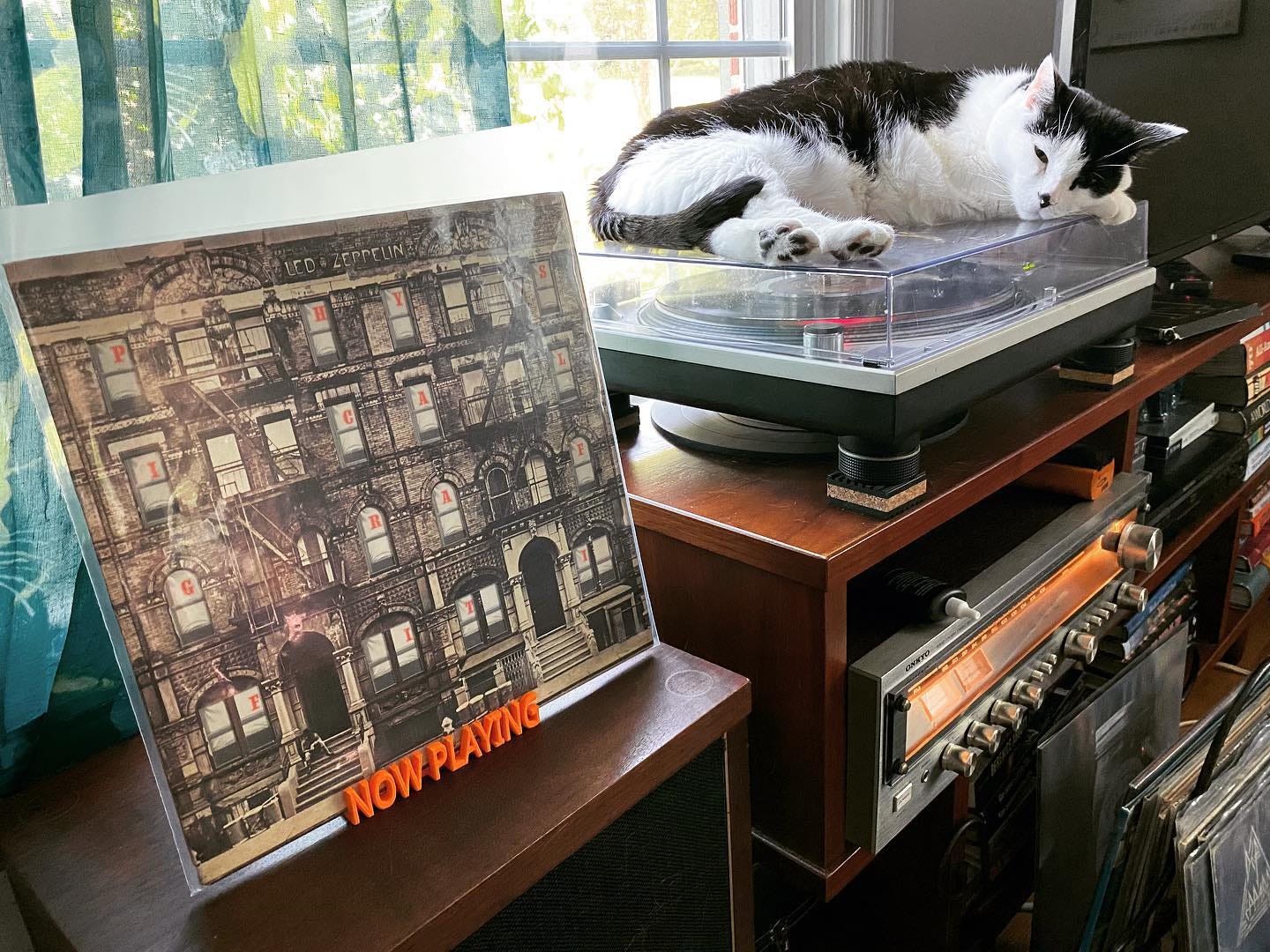
When my impossibly handsome cat Oscar passed away this past November, I started going through all the pics I’d taken of him during the 11 years or so we spent together. (He spent the last three years of his life in the loving care of my ex-wife, who made sure to update me regularly on his shenanigans.) In doing so, I discovered that I had taken dozens of photos of Oscar enjoying various albums with me — usually from his perch atop my turntable, where he could really dig the vibrations as the record spun.
I’ve decided to use these pics as the basis for “Oscar’s Picks,” a semi-regular series of posts which will be a nice way to keep his handsome memory alive, as well a prompt to write about some of my favorite records. I previously wrote about Le Chat Noir et Blanc’s enjoyment of Mink DeVille’s life-affirming Le Chat Bleu; this time out, we’re flashing back on a mighty slab of classic rock that recently celebrated its 51st anniversary…
Led Zeppelin broke up before I had the chance to truly get into them. That they were rock gods was never in question; from that moment in the fall of 1978 where I first began to actively explore the FM dial, I fully understood that they were beheld with awe by all who dug hard and heavy music. But they felt oddly remote to me — their last album had come out two years before I’d started caring about such things — and frankly, the first songs of theirs that I heard kind of spooked the shit out of me.
“Stairway to Heaven” had a dark melancholy to it that spoke of seeing or knowing things that mere mortals shouldn’t see or know, and the shrieking, confrontational assaults of “Whole Lotta Love” and “Black Dog” felt downright unsettling. As my initial hard rock tastes ran towards the well-manicured likes of Boston, Queen and Styx (though even “Renegade” sounded maybe a little too wild for ears tuned to such current AM radio stalwarts as the Bee Gees, ELO and Billy Joel), the raw racket of Led Zeppelin completely freaked me out at first. Was this the “acid rock” that I’d heard my fellow seventh graders talking about?
I finally found my way into Zeppelin appreciation nearly a year later, when In Through the Out Door dropped in the late summer of 1979. It was clear from the excited press coverage that the album, the band’s first since 1976’s Presence, was a major pop cultural event; and like any self-respecting 13-year-old, I wanted to be in on what was happening. I genuinely liked the two tracks from the album that were getting the most airplay — “All My Love” and “Fool in the Rain,” both of which were far more melodic and approachable than anything I’d previously heard by the band. So now I could at least say, “Yeah, Zep’s cool” to my junior high friends during our lunch-break music discussions without feeling like a total poser.
My Led Zeppelin education ramped up a bit upon my late-’79 move to Chicago, where local FM rock powerhouse WLUP was inclined to “get the Led out” on at least an hourly basis. I dug much of what I heard, but still wasn’t quite sure how to approach buying a Zep LP; with the exception of their self-titled first album and Led Zeppelin III (the latter of which only had one cut — “Immigrant Song” — that WLUP ever played), none of the Zeppelin albums I saw in the bins at Downtown Records seemed to list their songs on the cover. Plus, many of Zep’s songs had titles that didn’t sync up with their choruses, and fear of being mocked as “uncool” prevented me from asking the guys behind the counter which Zep albums had the songs I was looking for. It was only in May 1980, when a pal gave me a copy of 1969’s Led Zeppelin II for my birthday, that I learned what “What Is and What Should Never Be” — then as now one of my favorite Zeppelin songs — was actually called.
That copy of Zeppelin II would be the only Zep album I owned for years, as my listening interests soon began to veer towards artists like Bruce Springsteen and The Clash, whose passions and personas felt far more relatable to me than Robert Plant dreamily invoking “the darkest depths of Mordor” or squealing about getting his lemons squeezed. So when word went out that fall that Led Zeppelin were going to play four nights at Chicago Stadium, I was not among the several kids from my new high school who camped out in front of the Tribune Tower on the evening of September 24, in order to be among the first to grab the mail-order ticket application that would be running in the September 25th issue of the Chicago Tribune. Not that I could have afforded to buy a ticket, even if I’d wanted to go; and anyway, John Bonham’s tragic and untimely death — which most likely occurred while my friends were all still standing in line — unfortunately rendered the whole thing moot.
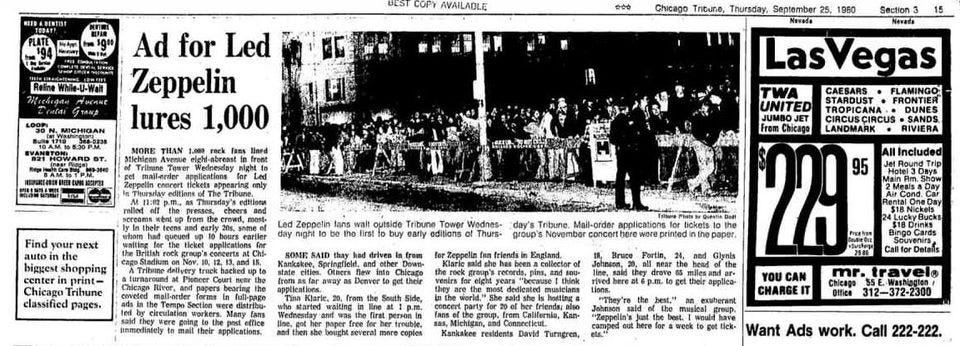
While that year’s deaths of Bon Scott and John Lennon only further piqued my interest in their respective music, Bonzo’s accidental demise somehow made me completely lose my appetite for Led Zeppelin. And when rumors (denied at the time though they turned out to be completely true) began flying in the fall of 1981 that some surviving Zep members were discussing forming a band with some former members of Yes — to be called XYZ, as in “Ex-Yes and Zeppelin” — this was all the confirmation I needed that Led Zeppelin were the epitome of the bloated, arena-quaking dinosaurs that punk rock (to which I was now a belated convert) had arisen to eradicate. Throw in the stories about underage groupies, taking writing credit for songs actually penned by old blues singers, and Jimmy Page’s occult obsessions and heroin addiction… and, well, fuck those guys.
I remained firmly prejudiced against Led Zeppelin and all their subsequent endeavors (The Firm? More like The Flabby, amirite?) until early 1987, when a female college friend gave me a mix cassette that included a couple of Zeppelin songs I hadn’t heard before — “The Ocean” from 1973’s Houses of the Holy, and “Nobody’s Fault But Mine” from Presence. In retrospect, the tape was probably a “Hey, I really like you” signal that I was too dense to pick up on; what I most assuredly did not miss, however, were the incredible guitar riffs and slamming drum grooves that drove both those Led Zep songs.
Excited by these new-to-me tracks, I approached Bob, the bassist of my campus band Voodoo Sex Party, and suggested that we cover one of them. VSP was primarily a punk- and garage-oriented trio, but this was during a period when punk and hardcore bands had begun covering hard rock songs of the 1970s — ostensibly in parodic jest, but really more as a means to reclaim (and turbocharge) the mighty guitar riffs that had so fascinated us in our younger years. Voodoo Sex Party was already playing Sweet’s “Fox on the Run” and Alice Cooper’s “I’m Eighteen” alongside our Ramones, Hoodoo Gurus and Stiff Little Fingers covers, so why not a Led Zeppelin deep cut? Bob was right there with me, but he had another idea: “How about ‘The Wanton Song’?” he suggested. “It’s like ‘Immigrant Song,’ but even better!”
I had never heard “The Wanton Song” before, or even heard of it — primarily because the track was hidden away on Side Four of 1975’s Physical Graffiti, an album that I had also never actually heard before. I made a mental note to check it out… and just a few days later, when I saw local art-punks Agitpop open their set with an agreeably angular cover of “Houses of the Holy” (which, in typical Zeppelin fashion, was not actually included on Houses of the Holy), it felt like the universe was somehow steering me towards a rendezvous with Physical Graffiti.
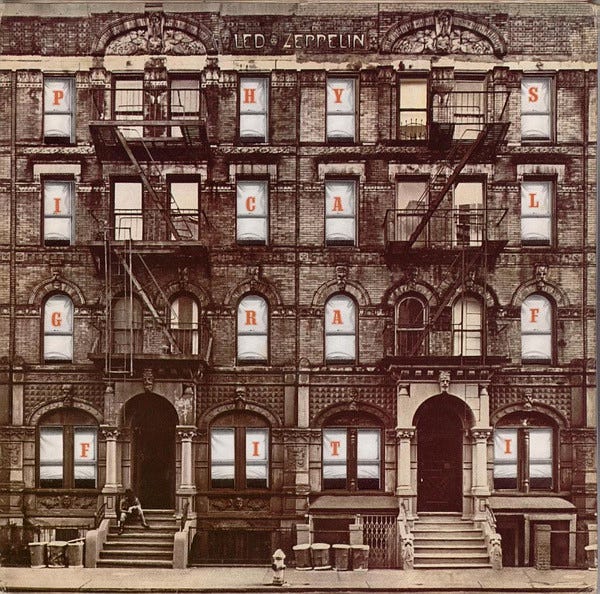
How had I never managed to hear Physical Graffiti — an album that sold over 500,000 copies the week of its February 24, 1975 release, and which has been hailed as one of the band’s finest outings ever since — before 1987? My best guess is that none of the kids I hung out with during my brief initial flush of Zeppelin fandom had actually owned a copy… which in turn was probably because, as a double album, Physical Graffiti was always the most expensive record in the Zep bins back then, and thus a little beyond the budget of your typical eighth grader.
I somehow already knew that the majestic “Kashmir” and “Houses of the Holy” lurked somewhere within its amusingly die-cut Hipgnosis cover; but when I borrowed Bob’s copy of the album to tape it, I was surprised to find that three other songs from the album’s first two sides also sounded familiar: “Custard Pie,” “The Rover” and “Trampled Under Foot,” all of which I vaguely recalled from my WLUP days, though I hadn’t known their titles until now.
The only track from the first half of the album that I definitely hadn’t heard before was “In My Time of Dying,” the spine-chilling 11-minute interpretation of Blind Willie Johnson’s gospel blues that closes Side One. The first time I listened to the track, I sat there completely slack-jawed and spellbound, marveling at how the band’s muscular, dynamic attack further accentuated the song’s eerie fatalism. A year later, Robert Plant would single out “In My Time of Dying” as one of Zeppelin’s high-water marks in an interview with Musician magazine, and I would totally understand where he was coming from.
We never ended up covering any Zep tunes in Voodoo Sex Party — guitar-wise, they were simply out of my reach at the time. But Bob’s copy of Physical Graffiti both fully rekindled my love for the band, as well as introduced me to what has long been my favorite Led Zeppelin album.
I thought at the time (and still believe) that sides One and Two could have made for an incredible single LP in their own right. Sure, a cut from Side Four like “Night Flight” or “The Wanton Song” could have been added to push things over the forty-minute mark; but even so, the first six tracks of Physical Graffiti add up to 39:06 of diamond-hard perfection, and as a two-sider it could have easily held its own against any of the band’s five previous albums.
But because the band already had more new material than they could fit onto a single album — and because Jimmy Page couldn’t resist the opportunity to go for the grand artistic statement — a decision was made to expand Physical Graffiti to four sides, combining eight newly-recorded songs with seven outtakes from previous albums. And in the process, Zep wound up serving up one of my all-time favorite Side Threes.
Sure, I have heard plenty of good-to-great double studio albums over the decades; but The Who’s Quadrophenia and ELO’s Out of the Blue are the only ones I can think of where the third side is my absolute favorite of the four. Quadrophenia’s Side Three is not only where the story’s action really ramps up, but it also contains four of the album’s strongest songs in a row: “5:15,” “Sea and Sand,” “Drowned” and “Bell Boy”. On Side Three of Out of the Blue, Jeff Lynne strings together four thematically-linked songs — “Standin’ in the Rain,” “Big Wheels,” “Summer and Lightning” and “Mr. Blue Sky” — into one gorgeous suite (Concerto for a Rainy Day) that I never tire of listening to. Still, there’s something about Side Three of Physical Graffiti that tops the both of them for me.
Maybe it’s the way the side’s four songs — “In the Light,” “Bron-Yr-Aur” (an outtake from Led Zeppelin III), “Down by the Seaside” (an outtake from Led Zeppelin IV) and “Ten Years Gone” — open the window and let some fresh and fragrant oxygen into the room after the almost claustrophobic intensity of the first two sides. Maybe because the side represents Page’s grandest and most fully-realized expression of his “light and shade” approach, with its broad array of musical colors and textures dexterously woven together. “In the Light”’s airy synthesizer drone leads into a thunderous hard-rock stomp that dramatically falls away to reveal John Paul Jones’ stately Clavinet figure and Page’s triumphantly ascendant guitar line… waves of Page’s Leslie’d guitar gently wash up against Jones’ buoyant electric piano on the wistful “Down by the Seaside”… and the way Page gorgeously layers guitar after guitar on top of the elegiac “Ten Years Gone” is absolutely masterful.
Or maybe it’s the way that everything on Side Three is perfectly mixed and sequenced to really transport you somewhere when you’re listening on headphones, which is my preferred way to absorb it. Even “Bron-Yr-Aur,” essentially just a solo acoustic guitar instrumental, subtly readjusts the guitar’s place in the stereo spectrum throughout the song, which makes it feel like Page’s fingers are dancing nimbly across your frontal lobe. In any case, I always walk away from a headphone session with Side Three of Physical Graffiti feeling refreshed, inspired and cleared of whatever nonsense had been cluttering up my brain beforehand.
I wasn’t listening to the album on headphones the day the above photo was snapped, however. After years of listening to taped or digital copies of the album, in March 2021 I’d decided that it was finally time to shell out for a clean original vinyl pressing of Physical Graffiti — even if obtaining one cost me significantly more than it would have done back in the day at Downtown Records. When my copy arrived in the mail from a Discogs seller (along with a Near Mint copy of Herb Alpert’s Rise, which had been shockingly difficult to find in such pristine condition), I immediately plopped it down on the turntable to give it a spin.
The copy sounded fantastic… but it was only when “In the Light”’s synthesizer drone kicked in at the beginning of Side Three that Oscar felt compelled to hop up onto the turntable, where he grooved along until the final notes of “Ten Years Gone” faded away. Oscar knew, man.
You may also groove on the following…


I had to laugh when I read what you said about buying double albums as a kid. I’m 67 and still regularly get together with other old geezers to listen to music. We have discussed how we rarely bought double or more albums because we couldn’t afford them. We then circled around and bought those albums when we were older and had more disposable income.
Oscar had excellent taste in music. And fashion.