
Please Excuse My Tears
Flashing back on Orville Stoeber and Bang The Drum Slowly


I returned home on Sunday evening flying high from an absolutely wonderful birthday weekend in New York City, then awoke on Monday morning to the deeply sad news that singer-songwriter, artist, music-for-healing therapist and all-around cosmic cat Orville Stoeber had passed away.
I first crossed cyber paths with Orville in early 2015, when I was penning a weekly column for the Fox Sports website at the behest of friend and editor robneyer (better known as Rob Neyer). Titled “Bloop Hits,” the column examined the stories behind various baseball-related songs. It was at Rob’s suggestion that I dug into the musical aspects of the 1973 baseball film Bang the Drum Slowly — specifically, the scene in which players of the fictional New York Mammoths baseball team sing “Please Excuse My Tears” on a TV show. It was one of Rob’s favorite baseball film moments, and to the best of our combined knowledge no one had written much about it before.
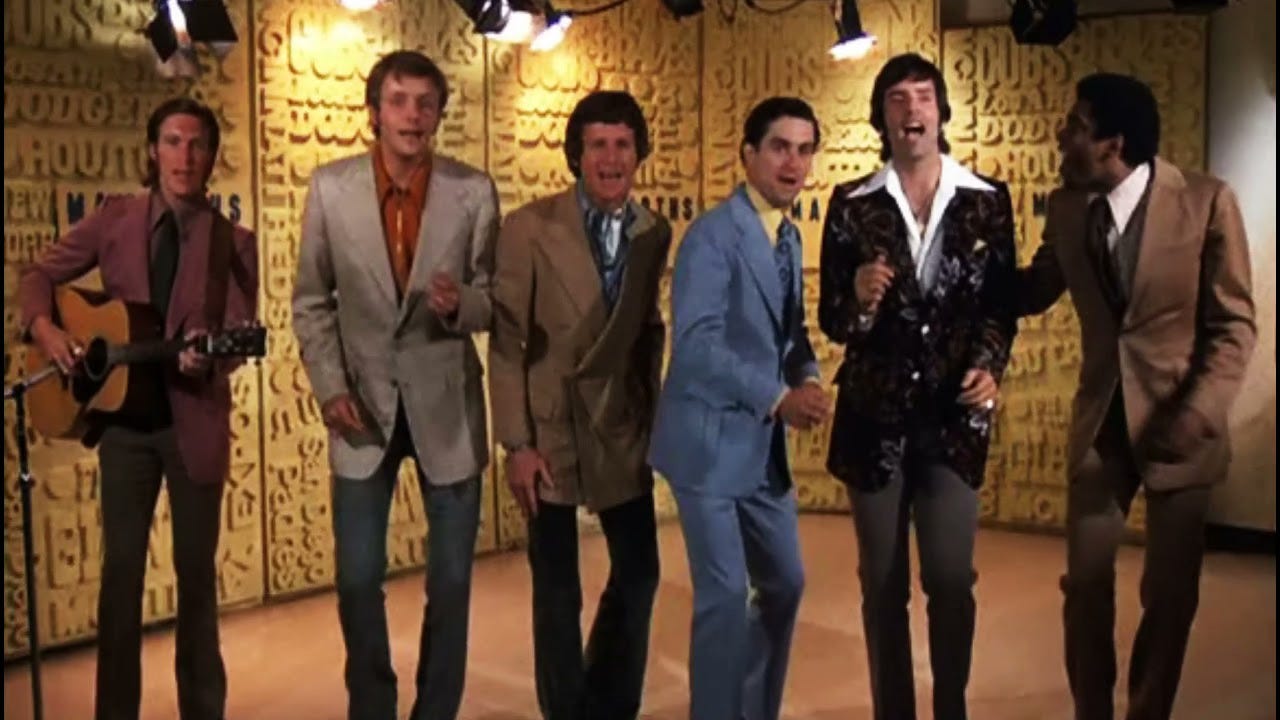
I gladly took the assignment, and I’m forever grateful for Rob’s suggestion. For not only did it force me to rewatch a favorite baseball film of my youth (but one which I’d generally avoided in my adulthood because it always made me blubber like a baby), but it also led to a decade-plus online friendship with Orville, the man who wrote “Please Excuse My Tears” (a.k.a. “Look Before You Weep”) and appeared strumming an acoustic guitar in that very “Singing Mammoths” segment Rob loved so much.
When our mutual friend James Fender introduced me to Orville via Facebook messenger (thanks again, James!), Orville seemed willing to tell me the story of his connection with the film, but also fairly wary; as with so many other talented, sensitive people, his brushes with the music and film businesses had left him with still-tender scars and reopened pre-existing wounds, and I could tell he wasn’t entirely stoked about revisiting the person he’d been in the early 1970s. He agreed to do the interview, but only if I emailed him the questions, and his written responses — while honest and enlightening — were gruffly succinct.
Given how brittle and prickly he’d seemed during our initial interactions, I worried that my Bloop Hits piece would somehow hit a wrong nerve with Orville — but he loved the published version so much that he immediately dropped his guard with me, as if he were a catcher flinging away his protective mask after the final out of a victorious game. I was living in L.A. at the time, and he invited me on a couple of occasions to join him and his son in Venice for drinks and baseball chat; sadly, I was never able to take him up on it, in part because I was getting ready to move to Chicago and thus dealing with a bunch of move-related stresses and time crunches.
Still, we kept in semi-regular touch thereafter via FB and the occasional email, and our exchanges — and his FB posts, which were some of my favorite things about being on that social media platform — allowed me full access to his playful spirit, his kind heart, his wry sense of humor, his thought-provoking and eye-popping art (which often mixed elements and symbols from numerous religions) and of course his wonderful music. Along the way, he also occasionally sent me some terse but loving messages of encouragement for my writing and music-making (along with a bit of good-natured shit for my Cubs fandom) all of which I deeply appreciated.
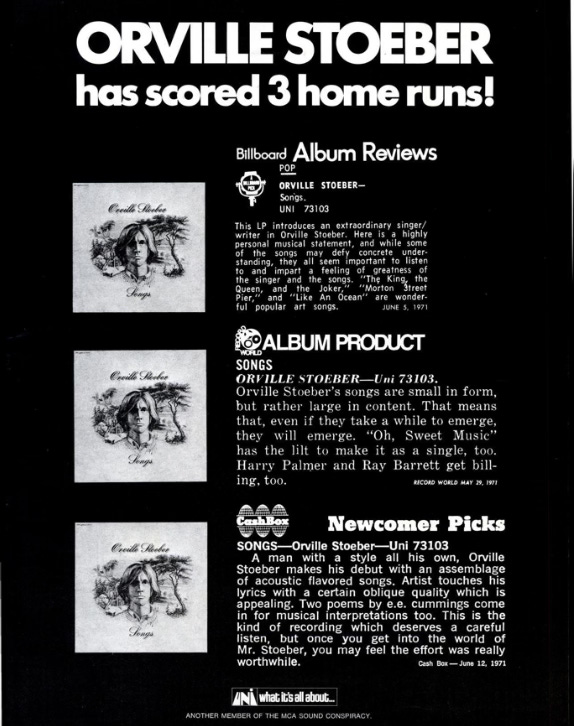
“I’m basically a songwriter, always looking for the next word and melody so I can finally quit,” he told me during our interview. “It’s not a great way to make a living or have a life.” And yet, he never stopped writing songs and making music, in part because doing it brought so much joy to others, and because he clearly connected with some sense of universal purpose while doing so. There’s a lot of great Orville Stoeber music out there, but my personal faves are Songs, his 1971 debut LP, and his gorgeous 2021 album Story Moon, which showed him still going strong 50 years down the road. Just start at either end of his discography, and see where it takes you…
So groove on, Brother O; may your beautiful soul soar ever higher. I’ll never forget you, your music or your friendship — and in your honor, I am re-running that Bang the Drum Slowly piece from Bloop Hits today…
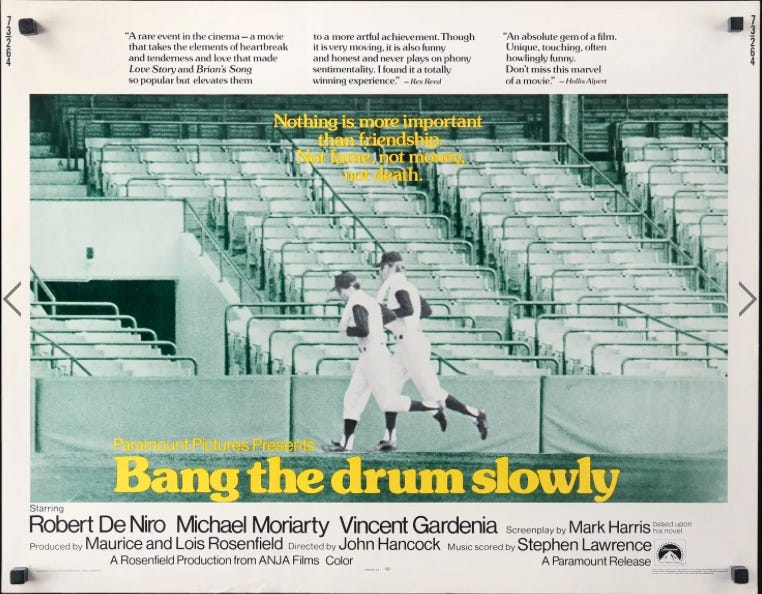
While there’s no box score or stats sheet I can dig up to prove it, I’m pretty sure that the first time I ever cried in a movie theater was during a mid-’70s screening of Bang the Drum Slowly.
Nearly 42 years after its initial release, John D. Hancock’s 1973 film is still a beautiful bummer, and remains worthy of inclusion on any list of great baseball flicks. Adapted from Mark Harris’ 1956 novel of the same name, about a country bumpkin ballplayer dying from Hodgkin’s lymphoma, Bang the Drum Slowly neatly sidesteps the cheap sentimentality and saccharine clichés that have marred so many films about the National Pastime.
The emotional power of this low-key drama derives from its portrayal of players as real people; the film shows us the sheer boredom of life on the road, the grind of the long season and the tension it creates between teammates, and the soul-crushing frustration of do-it-yourself contract negotiation during the pre-Free Agency era. Throw in a veteran catcher (played by Robert De Niro) whose skills are being steadily eroded by a terminal illness that he desperately wants to keep hidden from his teammates, and, well, I think I have some dust in my eye…
Which is not to say that the film is unremittingly bleak, by any stretch. There are a number of memorably humorous scenes throughout Bang the Drum Slowly, including the ones where New York Mammoths coach Joe Jaros (played by Phil Foster, better known to those suckled on ’70s sitcoms as Frank De Fazio, proprietor of Laverne & Shirley’s Pizza Bowl) and ace pitcher Henry Wiggen (played by Michael Moriarty) engage suckers in a card game called “tegwar” — which stands for “The Exciting Game Without Any Rules” — and there are several hilariously snappy exchanges between Wiggen and the Mammoths’ irascible manager Dutch Schnell, played by Vincent Gardenia.
Best of all is the “Singing Mammoths” segment, wherein six of the team’s players perform a song-and-dance number on a TV show. The performance includes some silly soft-shoe maneuvers courtesy of DeNiro’s character Bruce Pearson, whose teammates — unbeknown to him — are well aware that he’s dying, and have decided to include him in the fun despite his apparent lack of singing or dancing talent.
The song they sing, “Please Excuse My Tears” (often referred to as “Look Before You Weep”) was written by Orville Stoeber, an immensely talented singer, songwriter and composer, whose lovely 1971 album Songs is one of the era’s hidden musical gems. Stoeber actually appears in the scene, finger-picking on an acoustic guitar and doing his best not to crack up while watching his “teammates” stumble through their rudimentary choreography. Like the film itself, the story of how Stoeber came to be involved in Bang the Drum Slowly is redolent of a far less glitzy period of Hollywood history than our current one.
“I had worked with John Hancock on two of his previous films, scoring the Oscar-winning short Sticky My Fingers… Fleet My Fleet and Let’s Scare Jessica to Death, a low-budget horror film,” says Stoeber, who these days is based in Venice, CA, and is still active as a songwriter, artist and teacher.
“In 1972, I was living on 100th Street on the west side of Manhattan, crashing among various hippies and dope dealers — you could still afford to live in brownstone apartments then. I had recently been signed to a three-record deal with Uni/MCA; [my first album was] an artistic hit but otherwise a failure, and who cares about artistic hits? Anyway, I borrowed a friend’s Volkswagen, and drove to Nebraska looking for my first wife, who had left after the record debacle; after giving up on any possibility of reconciliation with my wife, and being thrown out of my father’s house in Missouri, I made my way to my sister Cathy’s in Chicago…
“So, I’m sitting in my sister’s house, drinking all my brother-in-law’s beer, when somehow Hancock tracks me down and says he needs a song for a movie about some guy who is dying. I picked up my guitar, walked into my sister’s living room and wrote ‘Please Excuse My Tears’ in five minutes. John called again; he asked if I could fly into New York and come to Yankee Stadium where they were filming and sing the song, which he had not heard.”
Shortly thereafter, Stoeber found himself enjoying the surreal experience of playing his newly-written song to Hancock and members of Bang the Drum Slowly’s cast and crew at The House That Ruth Built. “How do you end up in Yankee Stadium when you were piss-drunk in your sister’s garage the week before?” he says with a laugh.
Hancock thought the song, which Stoeber says “caught the tragic tone from my heart being broken by my first wife,” would be perfect for the “Singing Mammoths” sequence. In Harris’ book, the team’s singing group is a vocal quartet with a flair for barbershop classics like “Come Josephine in My Flying Machine,” but the director wanted something closer to the musical numbers that professional athletes often performed on the TV variety shows of the late 1960s and early 1970s, like Tom Seaver’s Lettermen-assisted 1969 appearance on NBC’s Kraft Music Hall.
“It was done in classic wing-it style,” says Stoerber of the scene, which was filmed at Shea Stadium, on the set of the Mets’ postgame show Kiner’s Korner. “I taught the song to the actors, they put me in make-up, and we filmed the scene. I would not let them cut my hair, so it is fairly long in the sequence.”
Stoeber says Hancock initially wanted him to play Piney Woods, the Mammoths’ guitar-slinging catching prospect who bums everyone out during a rain delay with his mournful rendition of “Streets of Laredo,” but that he was “too fucked up” to handle the role. (It was eventually given to actor Tom Ligon.)
But Stoeber did provide the poignant musical bed to the film’s most heartbreaking moment: the slow-motion sequence in which Pearson loses track of an easy pop-up during the Mammoths’ pennant-winning game. Nowadays, such a sequence would likely be set to a bombastic power ballad or obtrusively weepy Sarah McLachlan-type song; but here, Stoeber’s spare picking and wordless vocals delicately underscore the tragedy of the moment instead of hitting you over the head with it. “It is nice to work and have someone believe that you can accomplish something creative for them,” says Stoeber.
On a lighter note, Stoeber says that working with De Niro definitely left an impression upon him, though perhaps not in the way one might expect. While the actor’s next two roles, in 1973’s Mean Streets and 1974’s The Godfather Part II, would turn him into a huge star, Bang the Drum Slowly’s Bruce Pearson was by far the biggest role he’d played up to that point, so Stoeber was completely unaware of being in the presence of greatness when the two men crossed paths on the set. “Being the method actor that he is, De Niro never dropped out of character,” Stoeber recalls. “I thought he was just some cracker they got to play the dumb-ass catcher.”
You may also groove on the following:


John Hancock lives in my little town of Three Oaks, MI. He's most known for making the only movie set in said town called "Prancer" in 1989. Great guy. Thanks for the memory jog on this beautiful film, Dan and for allowing Stoeber's 1971 release "Songs" to be crackling through my speakers this morning.
Beautiful story..... it's been so long since I saw the movie and I don't think I saw all of it somehow. I have to fix this!