
We Can Be Gyros
Some brief thoughts on a handful of rock docs and processed meats

I had a very strange dream this past Friday night.
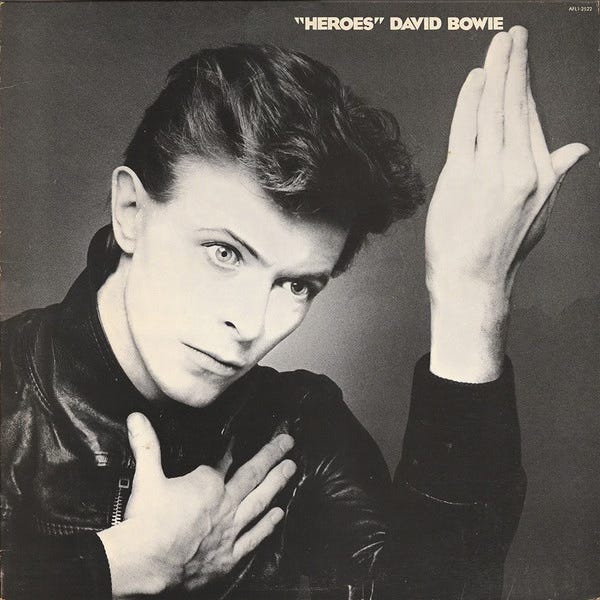
In it, I’d discovered a listing on eBay or Facebook Marketplace offering a corked bottle filled with air captured from the control room of Berlin’s famed Hansa Studios during the 1977 recording of David Bowie’s “Heroes” LP. Included as a bonus throw-in was a cured German salami, also from the “Heroes” sessions, which was still unopened.
I didn’t catch the seller’s asking price, as I was too distracted by the conundrum inherent in owning such a bottle of historic air: If you opened this one up in order to inhale the (presumably) same air that Bowie, Brian Eno and Tony Visconti had breathed during those momentous recording sessions, it would be gone in a millisecond and you’d be left with a worthless bottle. But keep it sealed, and you’ll always be tempted to open it, wondering if maybe a brief whiff of brilliance would actually be worth voiding the value of your investment. And then, right as I was about to wake up, I remember thinking, “How long does a cured, unopened salami stay ‘good,’ anyway?”
Neither of these issues have particularly troubled my thoughts since waking up on Saturday morning — though a quick Google search did indicate that, if anyone out there is still holding onto a salami pinched from any David Bowie recording session, you are definitely better off not eating it.
Where did this dream come from? I blame a Friday-evening viewing of the Netflix documentary Devo, in which Bowie makes a brief appearance (via archival footage of him introducing the visionary band before a 1977 gig at Max’s Kansas City) and Gerald Casale mentions getting sick from the processed meats laid out for breakfast at Conny Plank’s studio while recording their groundbreaking 1978 debut Q: Are We Not Men? A: We Are Devo with Brian Eno. Plank’s studio was located on the outskirts of Cologne, rather than in the center of Berlin — but hey, close enough.
Directed by Chris Smith, the 2024 doc does a brilliant job of showing how a couple of art-damaged misfits (Casale and Mark Mothersbaugh) were radicalized by the Kent State killings and channeled their rage and cynicism into performance art, early video experiments and eventually music — music which, despite often being written off at the time by many critics as a gimmick-heavy joke, remains hugely influential to this day.
By turns immensely amusing, deeply inspiring and extremely depressing — the band’s “theory of de-evolution” seems especially on-point these days — Devo makes it clear that Casale, Mothersbaugh and their bandmates were never kidding about what they were doing, even when the results were genuinely funny. The film also, as any good music doc should do, made me want to go back through the Devo catalog and reappraise some of their gems that I might have missed, especially on their later records.
My only gripe with the film is that, at barely over an hour and a half long, it leaves out a lot of Devo lore that could have been covered with even just another 10 or 20 minutes. The band’s jumpsuits are explained, for example — they were a nod to the industrial milieu of their Akron, Ohio birthplace — but there’s no mention of the band’s ziggurat-like “energy dome” hats, which are one of Devo’s most defining visual symbols. And I remember reading a great story a long time ago about how Casale and Mothersbaugh alienated the Akron art scene by showing up to gallery openings with the former in a gorilla suit and the latter leading him around on a leash; and whenever he got to a piece that he liked, Casale would make ape noises and do the “Poot” dance in front of it. I would have loved more color like that…
No matter, though; Devo is still a great doc, which both newcomers and longtime fans alike will surely dig.
It may seem a little late to be writing about Devo, which has been available on Netflix since last August; but as my girlfriend only recently re-subscribed to Netflix in order to give herself more viewing options while recovering from surgery, I’ve been trying to watch as many music documentaries on the channel as I can before she cancels the subscription. So the night after Devo, I figured it was time to finally check out Moonage Daydream, the 2022 Bowie documentary — which, if anything, only underlined how wonderfully concise and informative Devo was in comparison.
I had already read many reviews of Brett Morgen’s film over the past few years, so I wasn’t expecting it to follow the womb-to-the-tomb arc of your standard music doc, or to have a lot of talking heads chiming in about the brilliance of David Bowie. But I also wasn’t expecting to be bored, which — much as I love a good chunk of Bowie’s music, and continue develop a deeper appreciation for him as an artist, thinker and human being — I most definitely was.
Though the film is visually stunning, I found myself really getting annoyed by its repetitive use of certain clips and its emphasis on “vibe” over information; eventually, I just started wishing I could click over to watch some of the source material, be it D.A. Pennebaker’s Ziggy Stardust and the Spiders from Mars concert film, Alan Yentob’s Cracked Actor: A Film About David Bowie, Bowie’s acting roles in The Man Who Fell to Earth, Merry Christmas, Mr. Lawrence and The Hunger, or his TV interviews with Russell Harty and Dick Cavett. Hell, Bowie’s visionary brilliance comes through more clearly in the famous early-eighties MTV interview (not used in this film) where he upbraids VJ Mark Goodman over the video channel’s lack of Black artists than it does in this ponderous mess.
Much better (and far more engaging) was Bernard MacMahon’s 2025 doc Becoming Led Zeppelin, which — as per its title — focuses entirely on the British hard rock quintet’s formation and ascendance, ending just after the 1969 release of Led Zeppelin II.
I’ve seen some Zep diehards criticize the film for its lack of previously unseen footage — almost all the concert clips used here have been available on YouTube and elsewhere for years, though many of them have been nicely cleaned up for the doc — as well as several live clips where the audio and video is disorientingly mismatched, and the fact that it presents a rather sanitized version of the band’s often-messy story. (Which, as a documentary filmed with the endorsement and cooperation of the three surviving members of Zeppelin, pretty much goes with the territory.)
All that said, much of the live footage used in Becoming Led Zeppelin is genuinely thrilling no matter how many times you’ve seen it, and it’s a real treat to see Robert Plant — who is generally quite averse talking about the band in his latter-day interviews — speaking which such affection for his bandmates, the music they made, and the early adventures that they had together. (The newly unearthed audio interview with the late John Bonham is a wonderful addition, as well.)
Nearly 60 years after the band’s formation, Led Zeppelin’s music is such a fact of life that it’s almost impossible for a rock fan to imagine a time when it didn’t exist. But one of the best things about Becoming Led Zeppelin is that it really communicates how radical the band truly was in 1968 — not just in their fusion of folk, blues and heavy rock sounds, but in the way the band (and specifically Jimmy Page) fought for a far more equitable piece of the music-biz pie than most of their contemporaries were getting.
That Page would record the first Led Zeppelin album entirely out of his own pocket, and then use the finished product as leverage to pry an artist-friendly deal out of Atlantic Records — despite the fact that his band’s singer was a completely unknown quantity in the U.S. — speaks to his incredible vision, as well as to his unwavering confidence in what he and his bandmates were doing.
Do I wish the documentary had covered the rest of the band’s history? Sure, though it would have taken at least another four or five hours to do it justice; hell, just Physical Graffiti and the difficult tour that followed its release would have been worthy of at least an hour. Mostly, I just really love that, by limiting the chronological scope of the documentary, MacMahon was able to really drill down into the short but incredibly vibrant period it covers, rather than just hitting the obvious notes on a career-spanning overview. I’d love to see more music documentaries taking a similarly specific tack.
And right I was finishing writing this newsletter, I learned from a friend that It’s Your Thing, a documentary film of a massive June 1969 soul music concert at Yankee Stadium that hasn’t been widely screened anywhere since 1970, has suddenly appeared on YouTube. This is incredibly exciting news for an Isleys fan like me; the fact that the film also features performances by Ike & Tina Turner, The Five Stairsteps, The Winstons, the Edwin Hawkins Singers and Moms Mabley is just a very large cherry on the top of the soul sundae.
(For those of you keeping score at home, this is the concert that, according to Ernie Isley, his brothers had invited their old guitarist Jimi Hendrix to play — though he allegedly turned it down because it was too close to his Woodstock Festival commitment.)
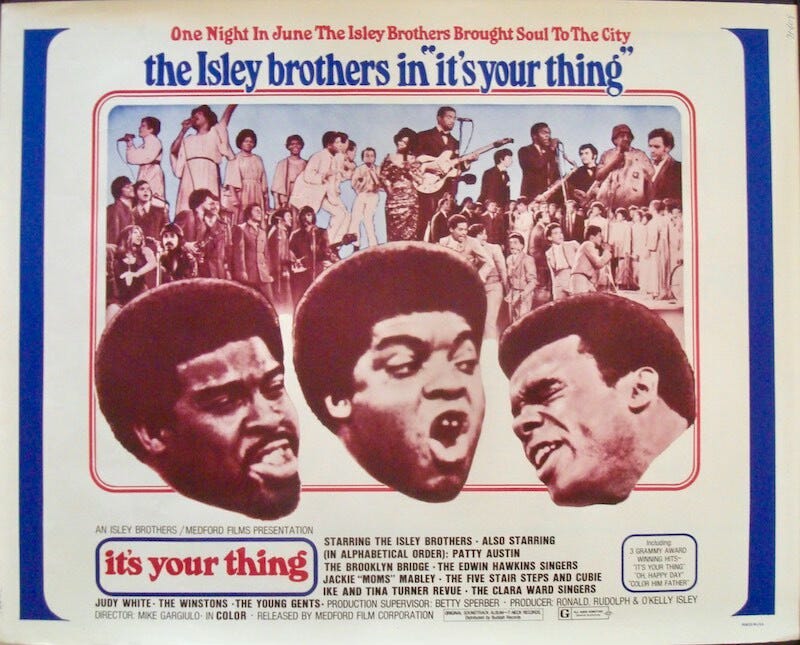
Anyway, I haven’t had time to watch and absorb the whole thing, but just a quick scan reveals that It’s Your Thing is an absolute bonanza of funky sounds and fashions — it’s definitely my thing, in other words, and it may be yours as well. Whether or not you pair it with some processed meats is, frankly, none of my business.
Part One is here:
Part Two is here:
You may also groove on the following:


Best post title yet. And the content ain’t bad either.
Thanks for the tip on It’s Your Thing! I was not aware…